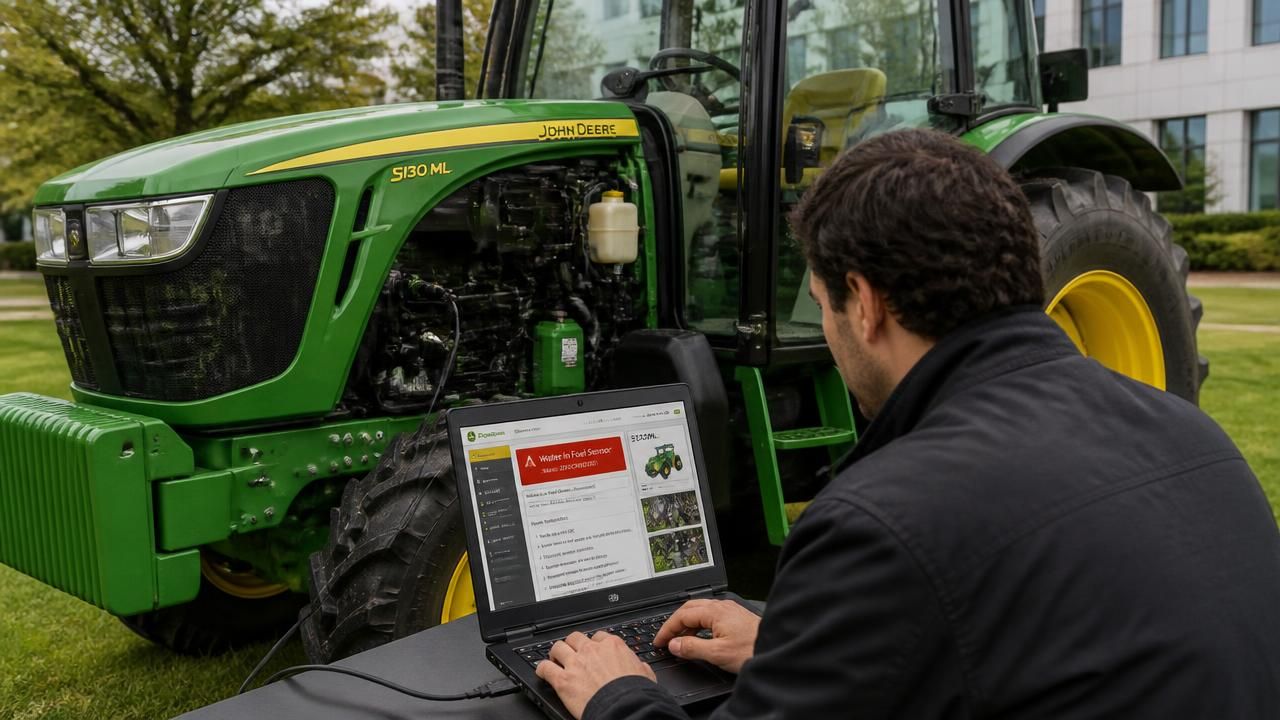
A Reporter, a Laptop, and a Tractor
SANTA CLARA, Calif. — The tractor sits on a patch of grass outside John Deere's corporate office here, a 5130ML model with a bright red notification on a nearby laptop screen. The water-in-fuel sensor, a small device embedded in the machine to monitor the integrity of its diesel engine, is disconnected. Someone has to fix it. That someone, for the purposes of a demonstration, is a reporter who is neither a mechanic nor a farmer.
A cable connects the laptop to the tractor. The software pulls up instructions and a few images from the user manual that matches the serial number of the machine. The reporter types in a question. The screen returns diagnostic information. With guidance from the system, the sensor is reconnected. The tractor is, at least in this narrow sense, repaired.
There is something wrong with the tractor. The water-in-fuel sensor, a small device embedded in the John Deere machine that monitors the integrity of its diesel engine, is disconnected. And I’ve got to fix it.
This is the promise of John Deere's self-repair service: giving customers the information they need to handle basic maintenance and repairs without waiting for a dealer. It is also the latest front in a long-running battle over who controls the increasingly software-defined machines that power modern agriculture.
What the Self-Repair Service Actually Does
John Deere's self-repair portal, part of a broader customer service platform, provides access to operator manuals, diagnostic trouble codes, and some repair instructions. In the Santa Clara demonstration, the system recognized the specific 5130ML tractor and delivered relevant documentation. The repair was simple: reconnect a sensor. But the company argues that this kind of access can save farmers time and money, especially for minor issues that would otherwise require a service call.
The service emerged from a 2023 memorandum of understanding between John Deere and the American Farm Bureau Federation. The agreement promised farmers and independent repair shops greater access to diagnostic tools, manuals, and software by 2024. Deere has since rolled out parts of that commitment, including the Customer Service ADVISOR tool and self-repair options. The company says it is balancing customer choice with security, safety, and environmental regulations.
Why Farmers Remain Skeptical
For many farmers, the demonstration proves both the potential and the limits of Deere's approach. Fixing a disconnected water-in-fuel sensor is not the same as diagnosing a transmission fault, calibrating a hydraulic system, or reprogramming an engine control unit. Those tasks often require dealer-only software and passwords that John Deere has historically refused to share. Critics say the self-repair service is a narrow concession designed to defuse political pressure while preserving the company's grip on the most lucrative repairs.
Farm equipment has become a high-tech industry. Modern tractors are rolling computers, packed with sensors, GPS guidance, and proprietary firmware. A single machine can cost more than $500,000. When it breaks down during planting or harvest, downtime can cost thousands of dollars a day. Farmers have long complained that dealer-only repair rules force them to wait days or weeks for a technician, even for problems they could fix themselves with the right information.
The right-to-repair movement has turned that frustration into legislation. States including Massachusetts, Colorado, and Minnesota have passed laws requiring manufacturers to provide access to parts, tools, and documentation. The Federal Trade Commission has also scrutinized repair restrictions, publishing a 2021 report titled Nixing the Fix that found many manufacturer policies were anti-competitive. John Deere faces lawsuits and regulatory pressure, and its MOU with the Farm Bureau was seen by many as an attempt to head off stricter rules.
The Right-to-Repair Battle Continues
Advocates say the self-repair service is a step, but not a solution. They point out that the portal may not cover all models, that it can require paid subscriptions, and that it still withholds the embedded software needed for deeper repairs. Independent repair shops, which many farmers rely on, say they remain locked out of critical systems. Security researchers warn that opening up firmware could create vulnerabilities, but right-to-repair proponents argue that auto manufacturers and other industries have shown that safe access is possible.
John Deere has argued that unrestricted access could allow customers to bypass emissions controls, alter safety systems, or violate intellectual property rights. The company says its self-repair service is part of a good-faith effort to give customers more options. But farmers are not sold. In interviews and surveys, they describe the portal as cumbersome and incomplete. Some say the real test is whether Deere will provide full diagnostic and repair capabilities without requiring a dealer visit.
Farmers aren’t sold on it.
The Santa Clara demonstration was carefully staged. A reporter, not a farmer, performed a simple fix on a tractor provided by the company. It showed that the software works for basic tasks. It did not show that a farmer could repair a combine in the middle of a harvest. That gap between demonstration and daily reality is why the right-to-repair debate is far from over.
What Happens Next
John Deere says it will continue to expand the self-repair service. State legislatures will continue to consider right-to-repair bills. The FTC and courts may weigh in. For farmers, the stakes are practical: can they keep their equipment running without being dependent on a dealer? For Deere, the stakes are financial and legal: how much control can it retain over its intellectual property while satisfying customers and regulators?
The tractor in Santa Clara is fixed. The water-in-fuel sensor is reconnected. But the larger question remains disconnected from any easy answer.
- John Deere's self-repair service offers manuals, diagnostic codes, and some repair instructions.
- Farmers and independent repair shops say it still withholds full software access.
- Right-to-repair laws and FTC scrutiny are pushing manufacturers to open up.
- The battle pits customer choice against security, safety, and intellectual property claims.