Six Nigerian nationals accused of belonging to an organized criminal network that allegedly swindled American women out of more than $6 million through online romance scams have been extradited from South Africa to the United States, authorities confirmed Friday.
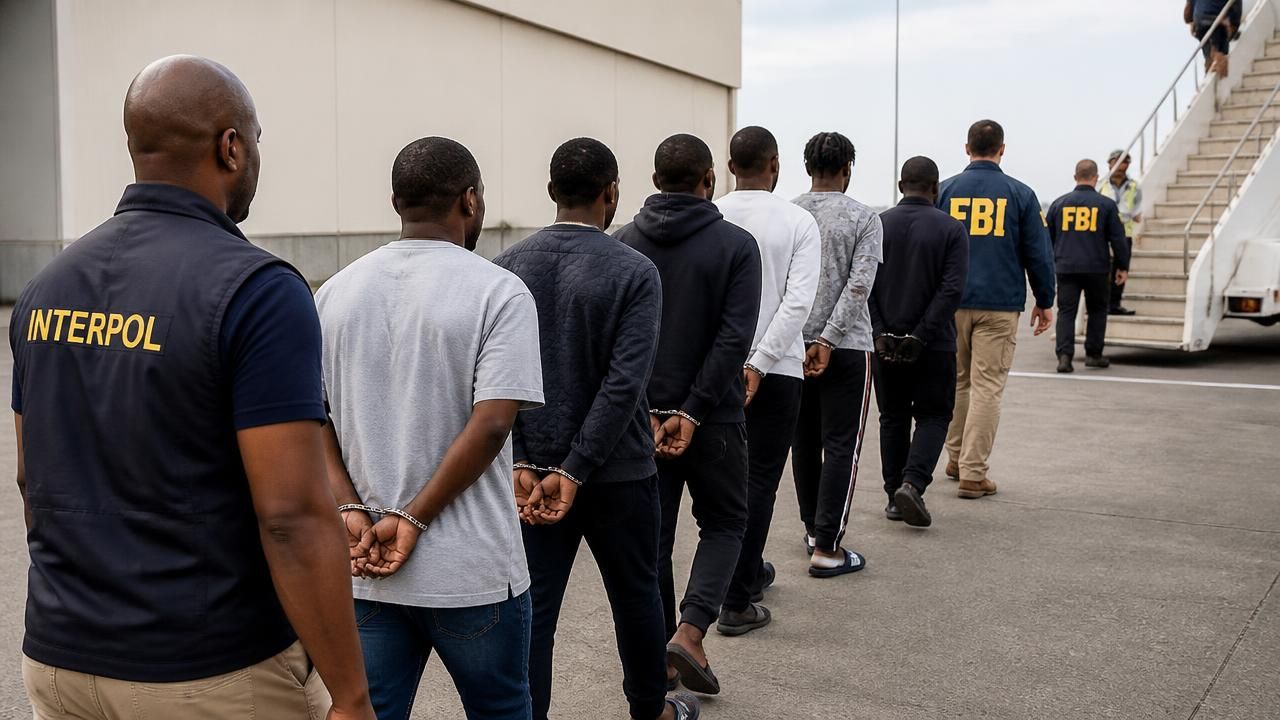
The men were handed over to officials from the FBI and the US Secret Service at Cape Town International Airport in an operation coordinated by South Africa's Directorate for Priority Crime Investigation — widely known as the Hawks — with support from Interpol South Africa. The transfer closed one chapter of a multinational investigation that stretched from West Africa to the American communities where the alleged victims lived.
South African police confirmed the six were to be extradited on Friday, with the Hawks facilitating their handover to FBI and Secret Service officials at Cape Town International Airport.
Who the suspects are
All six are Nigerian nationals who were allegedly operating under the umbrella of Black Axe, a network that began life as a university fraternity in Nigeria and has since evolved, according to law enforcement agencies on three continents, into a transnational organized crime syndicate involved in cyber fraud, trafficking and drug smuggling.
The men are accused of posing as romantic partners online, cultivating relationships with women in the United States and then persuading them to send money for purported emergencies — medical bills, customs fees, business setbacks or the cost of travelling to meet in person. Reporting on the case indicates that roughly 100 American women were targeted, with cumulative losses exceeding $6 million. That works out to an average of about $60,000 per victim, a figure that reflects how quickly a long-running online relationship can drain a retiree's savings.
A campus fraternity turned global crime brand
Black Axe, formally known as the Neo Black Movement of Africa, was founded at the University of Benin in the 1970s and has long since outgrown its student origins. Investigators in Europe, North America and West Africa have linked members to online fraud hubs, money-laundering operations and, in some cases, violence. The group's reputed reach across borders is precisely why the extradition required cooperation between South African police, Interpol and two US federal agencies with very different mandates — the FBI, which investigates fraud, and the Secret Service, which specializes in financial crimes.
How different outlets framed the story
The same set of facts produced notably different headlines. The Guardian emphasized the organized-crime dimension, leading with the Black Axe network and the multi-agency police operation. US outlets such as Newsday and al.com foregrounded the scale of the alleged con, stressing that American women were swindled out of $6 million. Other syndicated reports leaned on the most vivid detail available — that the suspects were "fake lovers" who wooed roughly 100 women — a framing that maximizes reader curiosity but says little about how the fraud actually worked.
Nigerian audiences, meanwhile, are likely to read the story through a different lens: as another data point fueling Western stereotypes about West African cybercrime, even as Nigerian authorities themselves have warned that fraud syndicates operate far beyond the country's borders.
Why extradition took years
Moving suspects between jurisdictions is rarely quick. Under the bilateral extradition treaty between South Africa and the United States, prosecutors must demonstrate dual criminality — that the conduct alleged would be a crime in both countries — and survive scrutiny by South African courts. The suspects' prolonged presence in South Africa also suggests the alleged operation ran through multiple countries, with South Africa serving as a base of operations rather than the origin of the scams themselves.
Once in US custody, defendants in romance-fraud cases are typically charged under wire fraud and money-laundering statutes. Each wire fraud count carries a statutory maximum of 20 years in prison, and conspiracy charges can add further exposure. The six are expected to appear before a US federal judge in the coming days.
The bigger picture: romance fraud is booming
The case lands amid a broader surge in what the FBI classifies as confidence fraud and romance scams. According to the bureau's Internet Crime Complaint Center, Americans reported losing more than $1 billion to such schemes in a single recent year — second only to investment fraud among all categories of cyber-enabled crime. Because victims often feel humiliated and decline to report, the true figure is believed to be substantially higher.
- Six Nigerian nationals extradited from South Africa to the US on Friday.
- Alleged losses exceed $6 million, with about 100 American women targeted.
- Suspects linked to the Black Axe organized crime network.
- Handover coordinated by South Africa's Hawks, Interpol, the FBI and the Secret Service.
Experts who study online fraud note that the tools available to scammers are improving faster than the defenses. Readily accessible translation software and, increasingly, AI-generated photographs and voice cloning make it cheaper than ever to fabricate an entire persona. Banks and payment platforms have tightened some controls, but romance scams frequently rely on victims authorizing transfers themselves, which defeats many automated fraud filters.
For the women named in the US indictment, Friday's extradition offers the prospect of a courtroom reckoning. For investigators, it represents something narrower and more practical: a demonstration that the distance between a Cape Town departure gate and a US courtroom is no longer a safe hiding place.