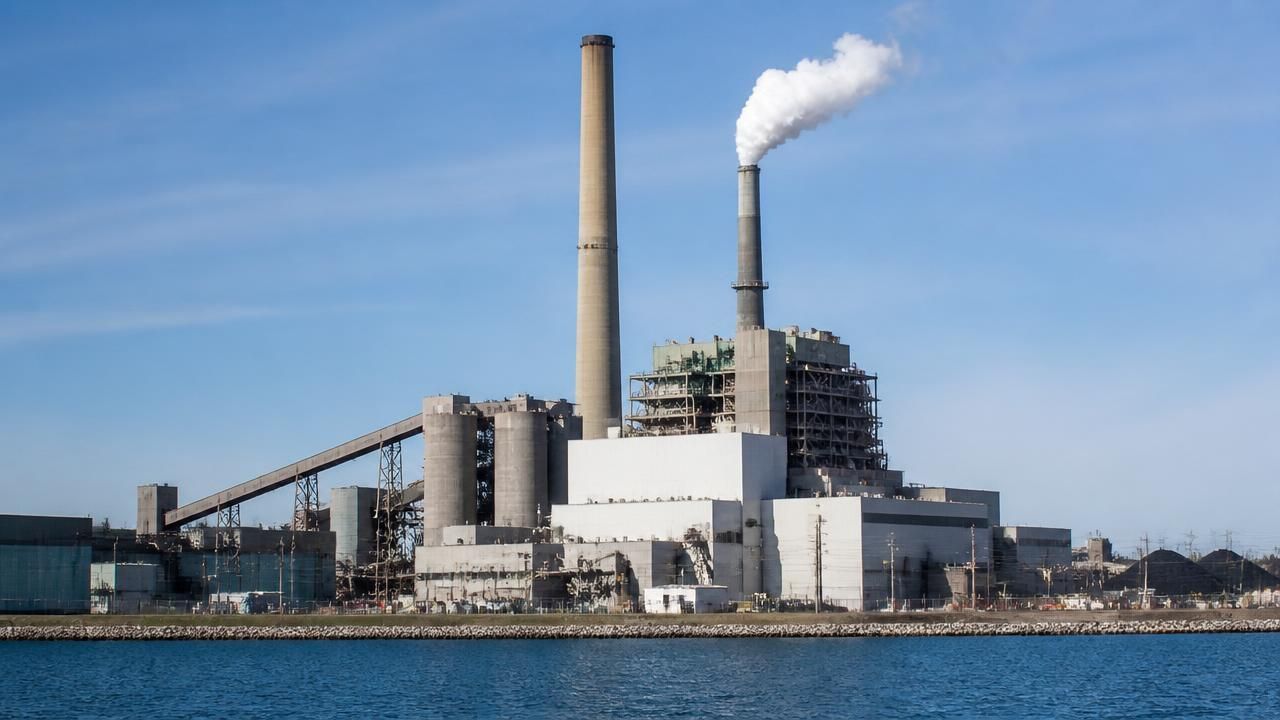
A federal appeals court on Friday struck down the Trump administration's attempt to force an aging Michigan coal plant to remain in operation, ruling that the Department of Energy had improperly invoked emergency powers to keep the facility running. The decision, issued by a unanimous three-judge panel of the U.S. Court of Appeals for the D.C. Circuit, marks the first judicial rebuke of the administration's strategy of using emergency declarations to delay coal plant retirements — and legal experts say its reasoning will apply to every similar order the agency has issued.
The case centered on the J.H. Campbell Generating Plant, a coal-fired facility in West Michigan that was slated to close last year. Instead, the Energy Department issued five separate emergency declarations to keep it operating, each capped at 90 days under the Federal Power Act. On Friday, the court held that those declarations were contrary to the statute.
The Plant at the Center of the Fight
The J.H. Campbell plant sits along the Lake Michigan shoreline and has long been one of the state's largest remaining coal-fired generators. Its owner, Consumers Energy, had planned to retire the facility as part of a broader shift toward cleaner and cheaper sources of electricity. The closure became a flashpoint after the Trump administration intervened directly, ordering the plant to stay online even though regulators and the utility had concluded it was no longer needed for grid reliability.
Michigan officials and a coalition of states, utilities and advocacy groups challenged the orders in court. The dispute was the first of several such cases to reach a decision, and its outcome was closely watched across the energy industry because dozens of other coal plants have been kept alive by similar federal directives.
How the Administration Justified It
The administration leaned on Section 202(c) of the Federal Power Act, a rarely used provision that permits the Energy Department to declare an emergency in times of war or when the grid faces a sudden shortfall in generation. As Ars Technica reported, the statute allows the agency to act when the U.S. is at war or when "an emergency exists by reason of a sudden increase" in demand.
Section 202(c) of the Federal Power Act allows the DOE to declare emergencies when the US is at war or when "an emergency exists by reason of a sudden increase" in demand for electric power.
The panel concluded that no such emergency existed. The court found the department's declarations did not fit the narrow conditions Congress wrote into the law, effectively rejecting the administration's claim that looming retirements — or projections of future tightness on the grid — amounted to the kind of sudden, unforeseen crisis the statute envisions.
Why the Ruling Resonates Beyond Michigan
Although the decision directly concerns a single plant in Michigan, its logic reaches much further. The same emergency-declaration mechanism has been used to block retirements at other coal facilities around the country, and the D.C. Circuit's reading of the statute undercuts the legal foundation for those orders as well.
Coverage of the ruling reflected the story's national stakes. The New York Times framed it as a court striking down a presidential order to keep an aging coal-burning plant running. CBS Detroit emphasized the local angle — a federal court rejecting an order affecting a West Michigan facility. Aggregators on MSN distilled the outcome into two competing headlines: one declaring that the plant "was illegally kept open," the other that the court "blocks Trump administration bid." The Environmental Defense Fund, which has fought the extensions, cast the decision as a rejection of federal "mandates extending aging, expensive coal plants past retirement," underscoring how environmental groups see the case as a test of whether the executive branch can override market and regulatory decisions.
Coal's Long Decline
The ruling lands amid a nearly two-decade slide in coal's share of U.S. electricity generation. Cheap natural gas, falling costs for wind and solar, and tightening environmental rules have pushed dozens of plants into early retirement. The first Trump administration was unable to reverse that trend; the second has pursued more aggressive interventions, including direct orders to keep plants open even when there is no demonstrated need for their output.
That approach has drawn criticism not only from environmentalists but also from grid operators and utilities, who argue that mandated extensions impose unnecessary costs on ratepayers and distort competitive electricity markets. Proponents of the orders counter that keeping coal plants available safeguards reliability, particularly as demand from data centers and electrification grows.
What Comes Next
The decision is limited in scope for now: the immediate effect applies to the J.H. Campbell plant and the specific declarations at issue. But because the D.C. Circuit is the venue where federal energy disputes are typically heard, its interpretation of Section 202(c) is likely to guide lower courts and constrain the Energy Department going forward.
The administration is expected to appeal, potentially pushing the question toward the Supreme Court. In the meantime, the ruling gives states and utilities a stronger hand in challenging federal orders that delay plant closures — and it signals that courts will scrutinize claims of grid emergencies that appear to rest on policy preferences rather than demonstrable crises.
For Michigan, the practical question is whether the plant will now be allowed to retire on schedule. For the rest of the country, the deeper question is how far the federal government can go in dictating which power plants stay open — a fight that Friday's decision has moved decisively in one direction.