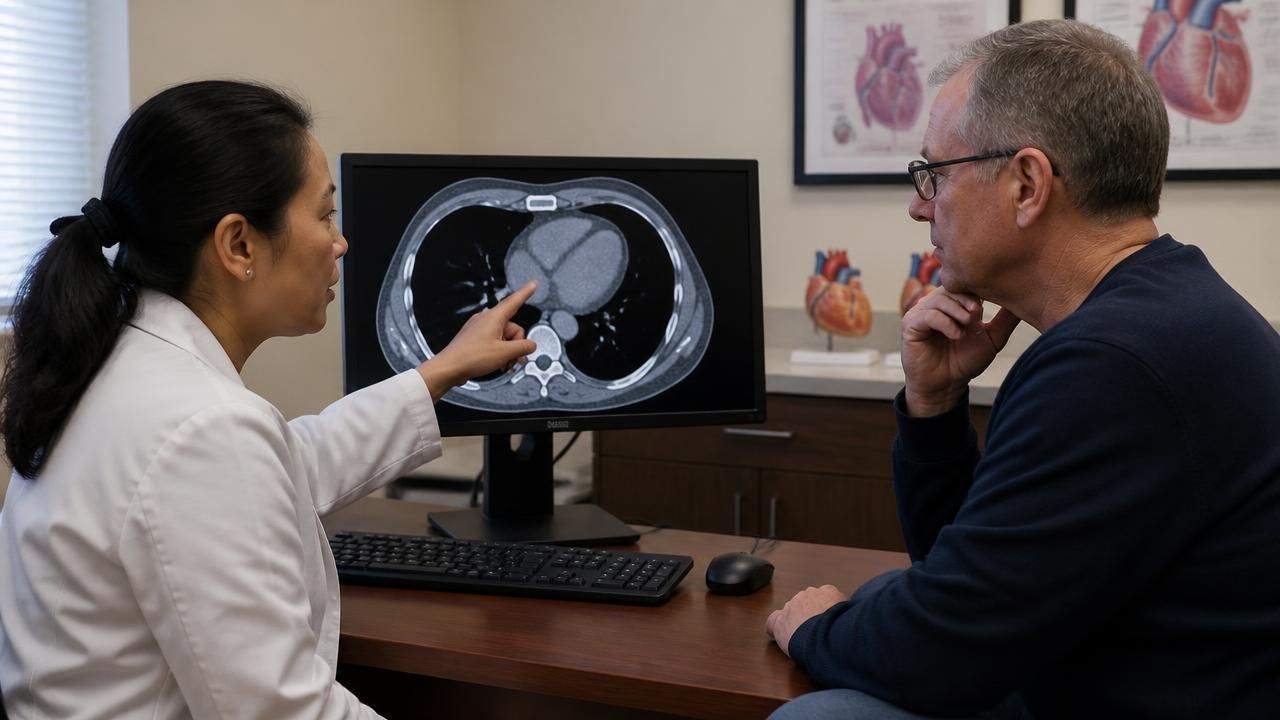
The coronary artery calcium scan has long been pitched as a straightforward way to peer into the future of a person's heart: a quick, painless CT test that reveals hardened plaque years before any symptom appears. A new 10-year study of more than 6,000 adults, however, suggests the picture is far more nuanced. For most people, the roughly $100 test adds little to what standard risk calculators already predict. But for one specific and sizable group — adults whose estimated risk falls in the borderline or intermediate range — the scan can serve as a decisive tiebreaker.
What the study found
Researchers followed more than 6,000 adults over a decade, comparing the predictive power of conventional heart disease risk factors — age, blood pressure, cholesterol, smoking status, diabetes — against the additional information provided by a coronary artery calcium (CAC) score. Their conclusion, as reported by ScienceDaily and echoed by Knowridge: for the majority of participants, the imaging test "may add little to standard heart disease risk estimates." The scan did not meaningfully reclassify risk for people who were already clearly low-risk or clearly high-risk.
Where the test earned its keep was in the middle of the distribution. For patients with borderline or intermediate risk, calcium scoring revealed who was actually more likely to develop heart disease over the next decade — information that standard equations alone could not supply.
The borderline case is the whole story
That finding has immediate clinical consequences, because the borderline patient is precisely the patient who is hardest to treat. A 10-year risk of, say, 7.5% to 20% — the gray zone where guidelines leave statin decisions partly to physician judgment and patient preference — is where most of the genuine uncertainty in preventive cardiology lives.
STAT News framed the result bluntly, describing the scan as a potential tiebreaker for people "on the fence about a statin." If a borderline-risk patient's calcium score comes back at zero, the case for lifelong medication weakens considerably. If the score is high, the case for treatment becomes substantially stronger. News-Medical emphasized the same targeting: the scan "may be most valuable for a specific group of patients."
The scan does not replace the risk calculator — it resolves the cases the calculator cannot.
What a calcium score actually measures
A CAC scan uses a low-dose CT scanner to detect calcified plaque in the coronary arteries, producing an Agatston score that typically runs from 0 upward, with higher numbers indicating more extensive calcification. The test requires no contrast dye, takes only a few minutes, and exposes the patient to a modest radiation dose. Its appeal is intuitive: it shows actual disease rather than inferring it from risk factors.
That appeal is also the source of its overuse. Because the test is cheap, quick, and widely available — often for around $100, as several outlets noted — it is frequently marketed directly to consumers who are worried but not necessarily at intermediate risk.
How the coverage diverged
The varying headlines around this single study illustrate how differently outlets translate the same evidence. ScienceDaily and Knowridge led with the question "Who really needs a heart calcium scan?" — a framing that foregrounds restraint. MSN took the consumer angle twice, once promising to reveal "who may benefit most" and once highlighting "the $100 heart scan that could reveal hidden heart disease before any symptoms appear," a headline that emphasizes the test's promise rather than its limits. News-Medical split the difference, calling it "most valuable for a specific group of patients."
The consumer-advice framing, represented by the syndicated Savvy Senior column, speaks to a real audience: older adults who see the scan advertised and wonder whether to ask their doctor for one. The study's answer is neither a blanket yes nor a blanket no — it depends entirely on where the patient sits on the risk spectrum.
The bigger debate: who gets a statin?
The study lands in the middle of a long-running argument about preventive medicine and statins. Guidelines from major cardiology organizations have shifted over the past decade, expanding and contracting the population recommended for cholesterol-lowering therapy. Critics on one side argue that risk calculators over-predict events and lead to over-medication; critics on the other argue that under-treatment leaves preventable heart attacks and strokes unaddressed.
A test that sharpens risk estimates in the ambiguous middle ground has obvious value to both camps — but only if it is used selectively. Applied to everyone, it adds cost, radiation exposure, and downstream testing without improving outcomes.
Caveats and what comes next
- Population studied: More than 6,000 adults followed for a decade — a substantial cohort, but one whose composition shapes how far the results generalize.
- Not a replacement for the basics: Blood pressure, cholesterol, smoking, and diabetes remain the foundation of risk assessment.
- Downstream effects unclear: Whether better-targeted statin use from calcium scanning translates into fewer heart attacks and deaths over a lifetime is a separate, longer question.
The practical takeaway for patients is narrow and useful. If your doctor tells you your 10-year heart risk is clearly low or clearly high, a calcium scan is unlikely to change your plan. If you are stuck in the uncertain middle, weighing a statin you are not sure you need, a $100 scan may be the most informative test available — not because it replaces the standard risk assessment, but because it fills in the one place where the standard assessment runs out of answers.