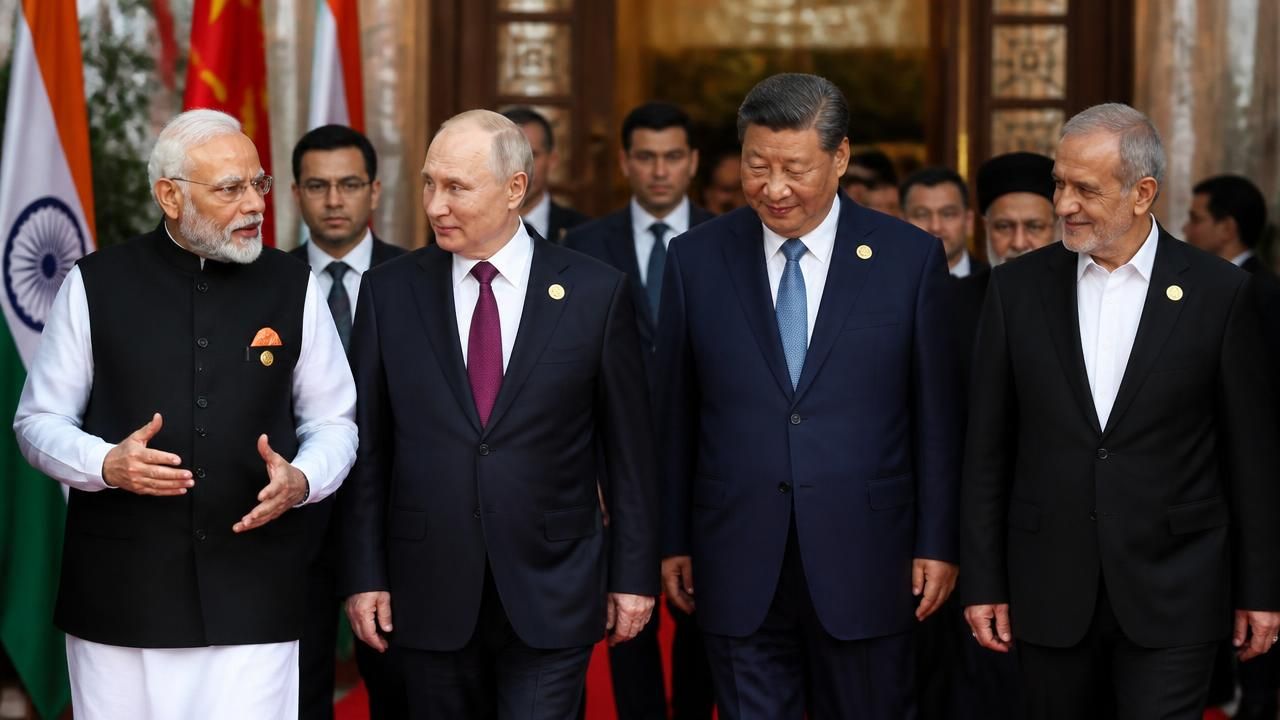
NEW DELHI — Indian Prime Minister Narendra Modi welcomed Russian President Vladimir Putin, Chinese President Xi Jinping, Iranian President Masoud Pezeshkian and other leaders to New Delhi this week for the 2026 BRICS summit, a gathering that has become as much a stress test of the bloc's unity as a showcase of its ambitions.
The summit brings together an expanded group of 11 nations — drawn from the original Brazil, Russia, India, China and South Africa core plus newer members — at a moment when overlapping wars, rising oil prices and deepening trade friction with Washington are reshaping the calculus for every delegation in the room.
A Bloc Seeking a Louder Voice
Officially, the agenda centers on trade, investment and global conflicts. In practice, the subtext is influence: BRICS members arrived in Delhi demanding a greater say in global affairs and pushing for greater financial independence from a system they argue is still dominated by Western institutions.
That message was echoed across international coverage of the opening day. RFI framed the gathering as a bloc "seeking greater global influence," while TeleSUR cast it as a meeting of "Global South leaders" pursuing "greater financial independence." For host India, the summit is a chance to present itself as a bridge between the industrialized West and the developing world — a claim that will be tested by the company it keeps.
“BRICS leaders gather in India as wars and US tensions test unity.”
— A recurring framing across Western coverage of the summit's opening day
Modi's Diplomatic Balancing Act
The most closely watched bilateral of Day 1 was Modi's meeting with Xi, which Indian officials said concluded with both sides stressing border peace, stronger ties and a more balanced trade relationship. The Ministry of External Affairs described the talks as productive, and Indian outlets treated the exchange as a signal that the two Asian giants are managing — if not resolving — their long-running frontier dispute.
Modi's parallel talks with Putin, held ahead of the full summit sessions, underscored the tightrope India is walking. Delhi has spent three years buying discounted Russian crude while courting Western investment and technology partners, a dual posture that analysts describe as the defining feature of Indian foreign policy in this era.
That balancing act is why several outlets — including Firstpost and Rising Kashmir — billed the summit principally as a diplomatic test for India rather than a test for BRICS itself. The question, in this framing, is not whether the bloc can agree, but whether India can host a group that includes Russia, China and Iran without damaging its relationships in Washington, Brussels and Tokyo.
Wars at the Table — and Iran's Seat
What distinguishes this summit from its predecessors is the guest list and the conflicts those guests bring with them. Putin's arrival in Delhi, covered by The Edge Singapore and others as a visit "shaped by wars, tariffs," came as the war in Ukraine grinds on. Pezeshkian's presence puts Iran — a BRICS member and a central actor in the region's escalating conflict — at the main table at a time when Western powers are largely locked out of direct dialogue with Tehran.
The New York Times captured that asymmetry sharply, noting that as oil prices climb, BRICS leaders have something the United States does not: Iran at the table. The point cuts two ways. It highlights BRICS' value as a channel of communication in a fragmented world, and it feeds Western suspicions that the grouping is coalescing into an anti-American front.
“As Oil Prices Rise, BRICS Leaders Have What U.S. Doesn't: Iran at the Table.”
— The New York Times
Economics, Tariffs and the Money Question
Beneath the geopolitics lies an economic agenda with real consequences. Rising crude prices are straining import-dependent members, while US tariffs and export controls have pushed de-dollarization and alternative payment systems up the priority list. Moscow and Beijing have long championed settling trade in local currencies; Delhi, wary of undermining its own financial integration with the West, has moved more cautiously.
The compromise language that emerged reflects those divisions. According to Outlook India, members agreed on a joint declaration without naming any country — a classic diplomatic formula that allows 11 governments with sharply divergent interests to claim victory simultaneously. The omission is not a drafting failure but the price of consensus.
How the Story Is Being Framed
- Western outlets emphasized division, wars and friction with the United States, framing the summit as a test of whether the bloc can hold together.
- Global South and state-aligned outlets stressed financial independence, multipolarity and the group's rising weight in global governance.
- Indian media focused on logistics, bilaterals and outcomes — the Modi-Xi talks, the joint declaration, the day-by-day choreography of hosting 11 leaders.
The gaps in framing are themselves part of the story. Where one outlet sees a fractious coalition papering over its differences, another sees the institutional emergence of a counterweight to Western-led order.
What to Watch Next
Three things will determine whether Delhi 2026 is remembered as a turning point or a photo opportunity. First, whether the joint declaration translates into concrete steps on payment systems and development finance. Second, whether the Modi-Xi thaw survives the next border incident. And third, whether India can convert its hosting role into durable leverage — extracting concessions from both Washington and Moscow without being forced to choose.
For now, the summit's clearest achievement is simply that it happened: 11 nations, several of them at war or under sanctions, sitting at one table in a capital that has positioned itself as the world's most consequential swing state. Whether that table produces agreement or merely proximity is the question Delhi will carry into the next summit.