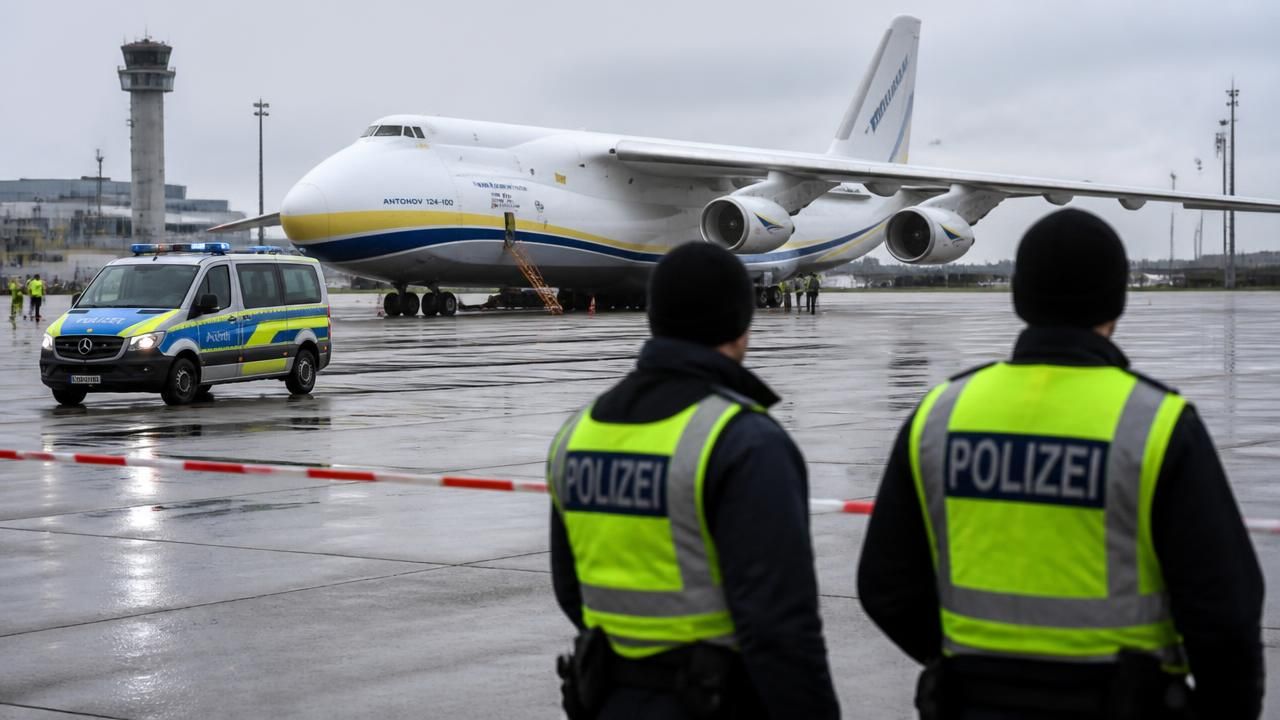
In a dramatic escalation of tensions between Berlin and Moscow, the German government has formally accused Russian military intelligence of orchestrating an explosive-laden drone attack on a Ukrainian cargo plane at Leipzig/Halle Airport last month. The accusation, reiterated in a classified briefing to parliament on Wednesday, marks the first time Germany has publicly attributed such an act of sabotage to the Kremlin on its own soil.
The incident, which occurred on the night of March 8, was initially reported as a security scare after airport personnel discovered a small unmanned aerial vehicle (UAV) bearing a homemade explosive device near the parked aircraft, a Ukrainian-operated Antonov An-124. The drone was found just meters from the plane’s fuel tanks, and its disposal required a specialized bomb squad.
German Interior Minister Nancy Faeser stated in a press conference that forensic analysis and intercepted communications provided "undeniable evidence" linking the attack to Russian military intelligence (GRU). "This was not the work of a lone wolf or a criminal group," Faeser said. "It was a state-sponsored act of aggression aimed at disrupting vital supply lines and intimidating Ukraine's civilian aviation."
What Happened at Leipzig/Halle Airport
Leipzig/Halle Airport, one of Europe’s busiest cargo hubs, has served as a critical transit point for Western military aid destined for Ukraine since the outbreak of the war in February 2022. The aircraft targeted, reportedly operated by Antonov Airlines, was scheduled to transport engineering spare parts and medical supplies to Kyiv when the drone was discovered during a routine perimeter security sweep.
According to security sources, the drone was a commercially available quadcopter modified to carry a C-4 plastic explosive charge connected to a remote detonator. The device failed to detonate, likely due to jamming equipment installed at the airport after earlier threats. Investigators later traced the drone’s flight path to a forested area outside the airport fence, where they found a packed bag containing additional components and a SIM card with encrypted communication logs.
"The signal intelligence is conclusive. The drone's control frequencies match GRU electronic warfare assets operating in the Baltic region," said a senior intelligence official who spoke on condition of anonymity. "This is a pattern we have seen in Poland, the UK, and now Germany."
Germany's Formal Accusation
The German government’s formal statement, delivered by Foreign Minister Annalena Baerbock, described the attack as "a grave violation of international law" and announced the expulsion of two Russian diplomats in response. "Moscow’s reckless actions endanger not only Ukrainian lives but also the safety of German citizens and the integrity of our critical infrastructure," Baerbock said. "We will not tolerate such covert warfare on our territory."
Berlin has also called on the European Union to adopt additional sanctions targeting Russian intelligence agencies, and has reopened a debate about increasing NATO’s air defense presence at civilian airports. The German federal prosecutor's office has launched a formal investigation, classifying the case as a "murder attempt" — a legal category that underlines the severity of the threat.
Unprecedented Public Accusation
While European governments have privately attributed a series of suspicious incidents to Russian intelligence since 2022, including arson attacks in Prague and sabotage plots in London, Germany has typically adopted a more cautious approach. This public identification of the GRU is seen as a watershed moment.
"Germany has long been reluctant to openly confront Russia due to its historical and economic ties," said Dr. Julia Volz, a security analyst at the German Institute for International and Security Affairs (SWP). "That calculus has changed. The war in Ukraine, the energy crisis, and now this direct attack on critical infrastructure have forced Berlin to abandon its reticence."
Putin's Response: 'A Grave Mistake'
Russian President Vladimir Putin, speaking at an economic forum in St. Petersburg on Thursday, dismissed the German accusation as "a grave mistake" lacking evidence. "Russia has no interest in provoking a direct conflict with NATO," Putin said. "These absurd claims are a provocation designed to distract from Europe's own security failures."
The Kremlin's official response accused Germany of "Russophobia" and demanded that Berlin provide the purported evidence to international inspectors. Russian Foreign Ministry spokesperson Maria Zakharova mocked the accusations, suggesting that "Germany's ruling elite has lost touch with reality."
Independent analysts note that Moscow has consistently denied involvement in similar incidents, including the 2018 Novichok poisoning in Salisbury and the 2020 naval mine placed near a German construction site in the Baltic Sea. However, Western intelligence agencies have documented a pattern of Russian sabotage operations aimed at degrading support for Ukraine.
Historical Context: A Pattern of Sabotage
This incident fits into a broader mosaic of suspected Russian covert actions across Europe. In January 2024, a fire broke out at a paint factory in Warsaw that produced military camouflage; Polish authorities linked it to Russian agents. In December 2023, British intelligence foiled a plot to assassinate a Ukrainian arms manufacturer. Even earlier, in October 2022, drones and undetonated explosives were discovered near the Nord Stream pipelines, leading to accusations of Russian involvement.
The use of drones specifically at airports represents an evolving threat. "The threat landscape has shifted from disinformation to physical sabotage," said former U.S. Air Force Colonel Sharon Price. "Drones are cheap, accessible, and can cause disproportionate damage. This attack failed, but the next one might not."
Implications for Aviation and Security
In the wake of the incident, German airport authorities have implemented enhanced counter-drone measures, including radio frequency jamming systems and drone-detection radar. The EU is considering a directive to mandate such systems at all major cargo hubs.
- Leipzig/Halle has become a lifeline for Ukrainian defense, with over 300 aid flights transiting monthly.
- Experts warn that a successful attack could have caused a catastrophic explosion, grounding tens of thousands of tons of critical supplies.
- Insurance rates for freight operators at European airports have risen sharply since the incident.
Ukrainian President Volodymyr Zelenskyy thanked Germany for its "vigilance and courage," stating that "Russian terror is not limited to our skies." The Ukrainian Ambassador to Germany, Oleksii Makeiev, called the attack "a new front in Putin's war" and urged allies to consider allowing Ukraine to use Western-supplied weapons to strike drone launch sites deep inside Russian territory.
What Comes Next?
Germany's accusation is likely to deepen the already severe rupture in EU-Russia relations. The federal government has openly prepared for possible retaliation, including cyberattacks or further sabotage attempts. Security officials have increased protection around airports, railway hubs, and chemical plants.
The diplomatic fallout is immense. The expulsion of Russian diplomats will almost certainly be reciprocated, further shrinking the already minimal communication channels between Moscow and Berlin. "We are in a legally ambiguous gray zone," noted Professor Gerd Rothschild, an international law expert. "Germany's claim of 'a murder attempt' suggests that Berlin is considering charges of state-sponsored terrorism, which could lead to decades-long sanctions."
Yet some voices urge restraint. Thomas Kiefert, a former German ambassador to Russia, argued that a direct confrontation over a failed attack could backfire. "We must be careful not to walk into Putin's trap," Kiefert said in an interview with Deutsche Welle. "He wants to portray Germany as a leading force against Russia. A measured response, focusing on resilience and deterrence, may be more effective than dramatic gestures."
For now, the investigation continues. The drone and its components have been sent to a specialized forensic lab in Munich, and scientists are attempting to trace the explosive's origin. The SIM card is being decrypted. The evidence, German intelligence asserts, is either "the fingerprint of the GRU" or "a masterful forgery" — and Berlin has committed itself to proving the former beyond any doubt.
As the war in Ukraine enters its third year, this incident at a quiet airport in eastern Germany has become another battleground. The stakes are high: if Germany's accusation holds, it will not only justify harsher sanctions but will also strengthen NATO's resolve. If it unravels, it could severely damage Berlin's credibility. For the Ukrainian pilots who fly these supply missions, the threat is existential.
In the hanger where the Antonov plane now sits awaiting clearance, technicians have installed a ring of unmarked surveillance drones of their own. The cat-and-mouse game over Europe's skies, it seems, has entered a new phase.