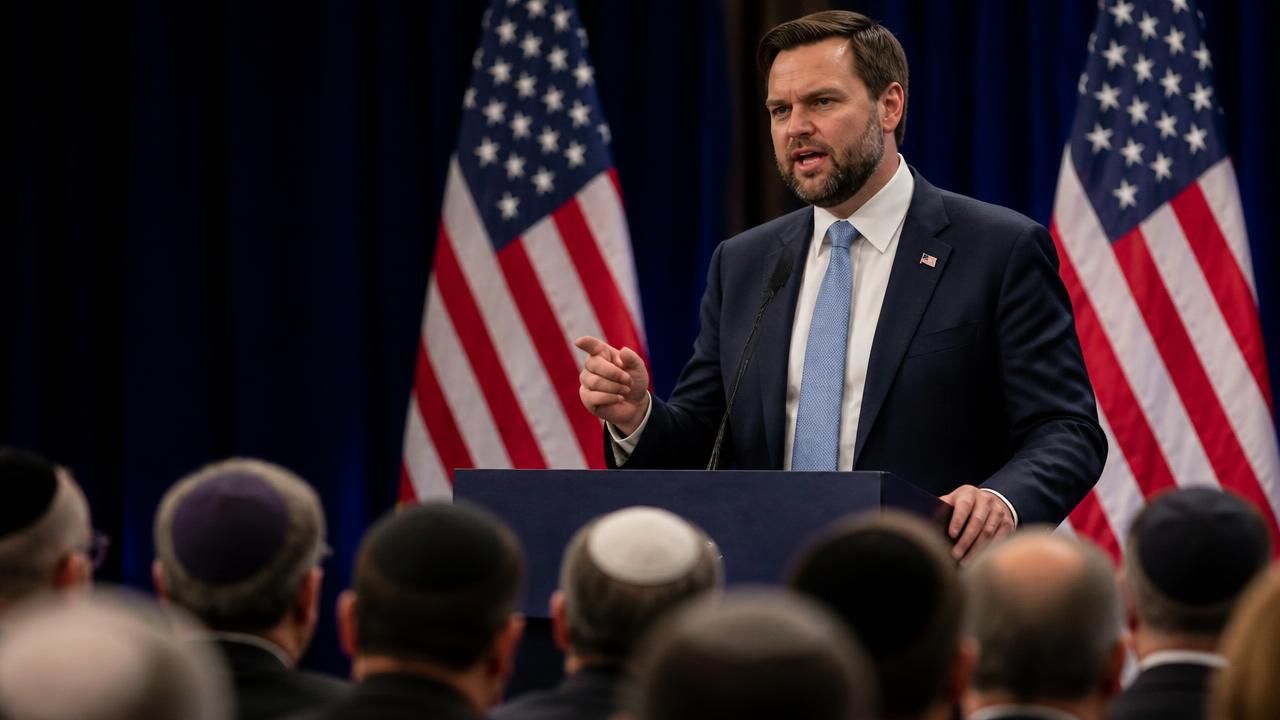
In a politically fraught moment for the Republican Party, Vice President JD Vance took his case directly to Jewish conservatives on Friday, delivering a closed-door address at the Republican Jewish Coalition’s annual leadership meeting in Las Vegas. The speech came amid mounting tension over the GOP’s relationship with far-right influencers accused of antisemitism — a debate sharpened by Tucker Carlson’s recent interview with Holocaust denier Nick Fuentes.
According to multiple attendees and reports from outlets including The New York Times, CNN, and the Jewish News Syndicate, Vance defended the administration’s engagement with figures like Fuentes, arguing that the party must not be in the business of “canceling” people and that dialogue can coexist with condemnation. He also urged the audience to help articulate why a strong U.S.-Israel relationship is in America’s interest — a message tailored to the pro-Israel crowd.
A Delicate Balancing Act
Vance’s appearance was both a peace offering and a political calculation. The RJC’s leadership had publicly criticized him earlier in the week after reports surfaced that he had appeared on Carlson’s show, which has provided a platform for Fuentes. Carlson’s interview with Fuentes, which aired on his online program, drew widespread pushback from Jewish groups and even some conservatives, with The Guardian noting that it “divides conservatives.” Vance, who has been a guest on Carlson’s show, walked a tightrope: he did not disavow Carlson outright, but he sought to reassure the Jewish GOP donor base that the administration remains steadfast in its support for Israel and opposed to antisemitism.
“He explained why he engages with some influencers accused of antisemitism,” a person familiar with the remarks told The New York Times. “He also urged the audience to help articulate why a strong relationship with Israel is in America’s interest.” The vice president’s message appeared to land unevenly. Some attendees left feeling reassured, while others voiced skepticism about whether the party can embrace figures with histories of Holocaust denial without eroding its moral authority. The Forward, a Jewish publication, posed the question bluntly: “Are Jewish Republicans willing to put up with Holocaust denial?”
Different Frames, Same Fault Line
Coverage of the event reflected a deep ideological split. CNN’s headline characterized Vance as trying to “have it both ways” on Fuentes and antisemitism, while MSNBC and other outlets highlighted that “some Jewish Republicans bashed JD Vance” before he came to speak. The RJC itself seemed torn between its traditional pro-Israel mission and the Trump-aligned base that has increasingly flirted with nationalist and sometimes antisemitic rhetoric. The New York Times’ analysis, “Why Republicans Are Fighting About the Nazis,” placed the controversy in a broader context: the GOP is struggling to define itself in an era when former President Donald Trump has downplayed white supremacist violence and platformed figures who traffic in ethnic slurs.
“The party is not having a fight about policy; it is having a fight about identity,” said one Republican strategist familiar with the internal dynamics. “The question is whether you can be a conservative and still reject the ugliness that comes with the fringe.”
The closed-door format was itself a tell. Vance spoke without cameras, allowing for a candid exchange, but also avoiding a public confrontation. The RJC’s decision to invite him after earlier criticism was seen as an attempt to keep the coalition unified ahead of the 2026 midterms, when Israel and antisemitism are likely to be wedge issues.
Why Israel and Antisemitism Have Become Flashpoints
The controversy does not exist in a vacuum. It comes as the Biden administration’s Israel policy has divided both parties, and as campus protests over the Gaza war have made antisemitism a national talking point. In a related development, California Governor Gavin Newsom this week expressed regret for comparing Israel to an “apartheid state,” illustrating how sensitive such comparisons have become. For Jewish Republicans, the dilemma is acute: they share the party’s hawkish Israel posture but are uneasy with the embrace of figures like Fuentes, who has called for the “total annihilation” of Jews and praised Hitler.
Vance’s remarks in Las Vegas were an attempt to bridge that gap. He reportedly told the audience that engaging with influencers does not mean endorsing their views, and that the broader goal is to build a winning coalition that includes disaffected voters. He also stressed that Israel’s survival is a strategic and moral imperative for the United States. Yet the undercurrent of discomfort was palpable.
What Happens Next?
The RJC meeting ends on Saturday, and the fallout is likely to continue. Republicans are now watching whether Vance will appear publicly with Carlson again, and whether the White House will explicitly distance itself from Fuentes and other extremists. Meanwhile, Jewish advocacy groups are pressuring GOP leaders to adopt a uniform stance against Holocaust denial, a move that would put them at odds with a segment of the online right. For now, the vice president has made his pitch — but the party’s internal fight over the souls of its allies is far from settled.
As one RJC attendee told The Daily Beast: “We need to know if this is a one-off or a pattern. Actions will speak louder than speeches.”