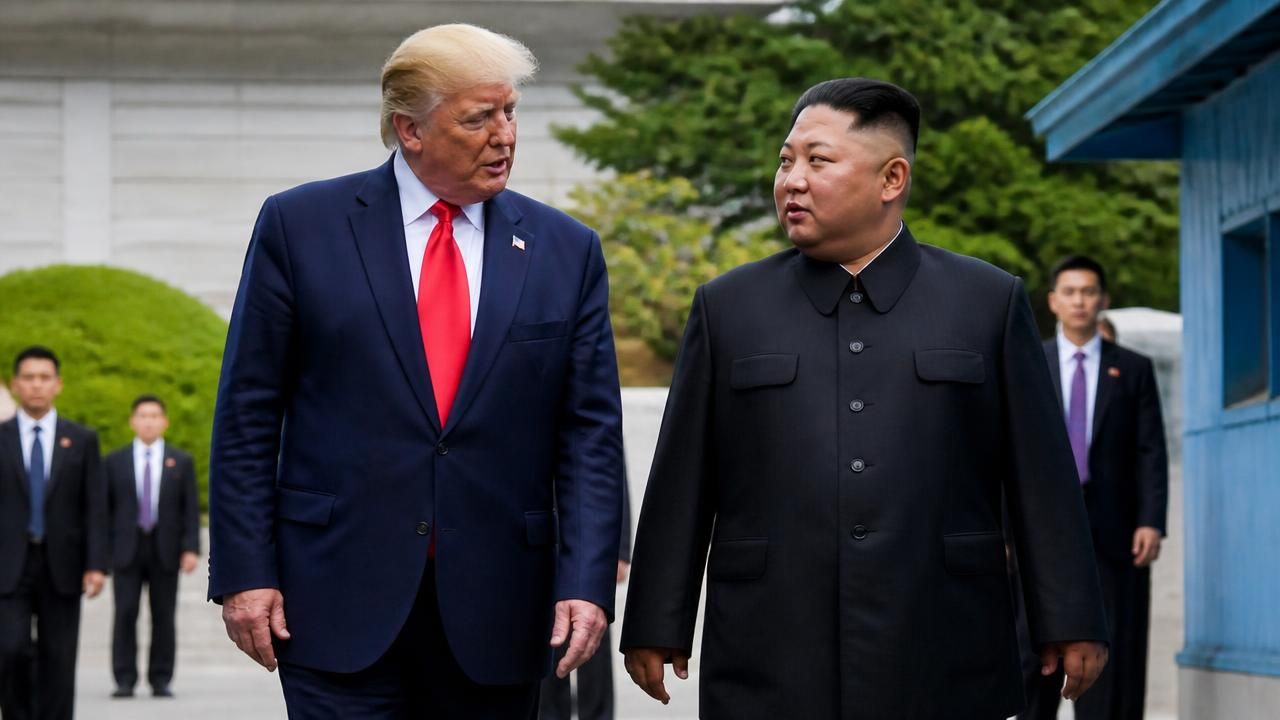
South Korea’s intelligence agency has signaled that a summit between President Donald Trump and North Korean leader Kim Jong Un could take place “at any time,” according to a lawmaker briefed by the National Intelligence Service (NIS). The rare assessment has rekindled hopes for diplomacy on the Korean Peninsula, even as evidence mounts that Pyongyang is accelerating its nuclear weapons program and preparing for new provocations.
Renewed Diplomatic Openings
Bloomberg Markets reported that the NIS sees signs of renewed dialogue between Washington and Pyongyang. Representative Lee Seong-woo, a member of South Korea’s parliamentary intelligence committee, told reporters after a closed-door briefing that the agency assessed a summit could happen “at any time.” Yonhap News Agency added that the NIS sees a high chance of a summit after March next year, coinciding with South Korea’s April elections.
“The possibility of a U.S.-North Korea summit is high at any time,” the lawmaker said, summarizing the intelligence briefing.
North Korea appears open to talks. Asianews.network noted Kim Jong Un has shown willingness to engage with Washington, and Reuters reported that Pyongyang is deliberately distancing itself from Iran to keep the door open for dialogue with the United States. In a rare statement, North Korea described its leader’s relationship with Trump as “not bad,” while insisting it has no intention of unilaterally giving up its nuclear arsenal. CNN observed that after witnessing how the U.S. handled Iran and Venezuela, Kim must now decide how to approach a second Trump administration.
A Dynastic Succession Takes Shape
One of the most striking developments is the apparent elevation of Kim Jong Un’s daughter, Kim Ju Ae. The BBC and Yonhap both reported that the NIS believes Ju Ae, believed to be around 10 years old, is “most likely” to succeed her father as North Korea’s next leader. The assessment is based on her frequent appearances at major public events, including missile tests and military parades, where she has been given prominent placement.
Bloomberg also noted a health mystery: Kim Jong Un has been seen with a bandage on his head, fueling speculation about his health and underscoring the opacity of the dynastic succession process. The NIS’s acknowledgment of Ju Ae as the likely heir adds a new dimension to the summit calculus, as any agreement with Kim would carry implications for the future of the regime.
Nuclear Buildup and Provocations
While diplomatic signals emerge, the intelligence community is also warning of continued nuclear expansion. NBC News reported that U.S. officials have concluded North Korea has increased nuclear fuel production at secret sites, a finding echoed by The Japan Times. Analysts also say the Sohae satellite launch site has been restored to normal operations, potentially enabling tests of intercontinental ballistic missiles or space launch vehicles. Kim opened a rare party congress by declaring that his five-year goals have been met, according to The Japan Times.
Furthermore, South Korea’s NIS sees a high chance of provocations ahead of the April elections, possibly including a seventh nuclear test. Türkiye Today cited Seoul as saying Pyongyang may seek a summit while simultaneously preparing a nuclear test — a dual-track strategy reminiscent of past negotiations. The Bulletin of the Atomic Scientists published an interview warning that national security officials are “way too confident” in their assessments of North Korea’s intentions, a caution against both alarmism and complacency.
A Legacy of Mistrust
The skepticism is well earned. Kim Hyun-hee, a former North Korean agent who bombed a South Korean airliner in 1987, told NBC News that “we should not trust Kim Jong Un.” Her warning reflects the experience of past summits, including the 2018 meeting between Trump and Kim in Singapore, which produced a vague denuclearization pledge but no tangible progress. Vox wrote that the main benefit of such meetings may be simply to avoid conflict, while also noting that a top Trump administration official once nearly doomed talks. The New York Times added a fascinating footnote: a top-secret SEAL Team 6 mission into North Korea fell apart, illustrating the dangers of military options. Analysts quoted by Vox describe what war with North Korea would look like — catastrophic casualties on all sides — making diplomacy all the more urgent.
Economic Potential or Investor's Nightmare?
Trump has long touted North Korea’s economic potential, describing it as a land of opportunity if peace can be achieved. But USA Today consulted experts who call the country an investor’s “nightmare,” citing its isolation, sanctions, and lack of legal protections. Kim Jong Un’s recent meeting with Russian President Vladimir Putin at a spaceport hints at deeper military cooperation, which further complicates any international business prospects. For now, the finance sector remains wary. Any summit-driven optimism would need to overcome structural hurdles and the regime’s own history of broken promises.
What Next?
The coming months will test whether the signals from Pyongyang translate into concrete diplomacy. With South Korea elections upcoming, the North may use provocations to influence the political landscape. Meanwhile, the U.S. presidential envoy has yet to be named, and there is no confirmed date for a new summit. What seems certain is that the world should prepare for both possibilities: a dramatic diplomatic breakthrough or a renewed escalation.
As South Korea’s intelligence community ventures its most optimistic assessment in months, the words of the defector-spy still echo: “Don’t trust Kim Jong Un.” Yet trust has never been the currency of great power diplomacy — only interests.