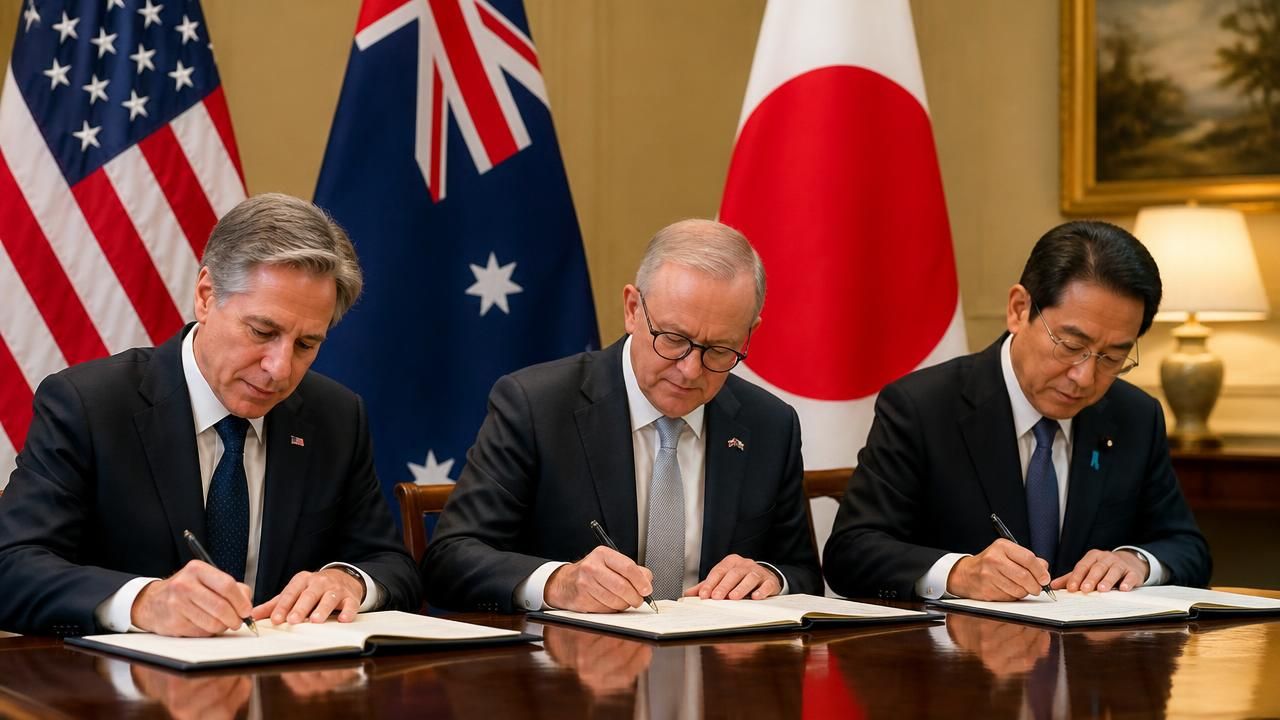
The United States and Australia have signed a landmark critical minerals agreement designed to challenge China's near-total dominance of gallium and other strategic minerals. As part of the deal, Washington will provide $174 million in financing to Alcoa Corp. to build a gallium extraction plant at its alumina refinery in Western Australia, with additional backing from Japanese industrial partners including Sojitz Corp. The broader bilateral pact, valued at approximately $2 billion, aims to secure supply chains for minerals essential to semiconductors, defence technology, and renewable energy.
A strategic pivot against Chinese control
Gallium is a soft silvery metal used in compound semiconductors, LEDs, radar chips, and advanced military electronics. China produces over 90% of the world's gallium, giving it outsized leverage over global tech and defence industries. In 2023, Beijing imposed export restrictions on gallium and germanium, sending Western governments scrambling for alternative sources. The new US-Australia initiative is the latest in a series of moves to reduce that reliance.
The Alcoa project will extract gallium from the refining process of bauxite into alumina, avoiding the need for separate mining. The company said in a statement that the facility would be one of the first large-scale gallium producers outside China. The project is also expected to create hundreds of construction jobs and dozens of permanent roles in Western Australia.
What the deal includes
The announcement follows months of negotiations between Washington and Canberra. Australian Prime Minister and US President hailed the agreement as a major step for economic security.
- $2 billion in combined US-Australian investment for critical minerals projects
- $174 million US government financing for Alcoa's gallium plant
- Japanese participation through Sojitz and other partners
- Focus on gallium, germanium, rare earths, lithium, cobalt, and other strategic minerals
According to Reuters, the agreement was announced ahead of a bilateral leaders' meeting, with both governments emphasising the need to diversify away from Chinese supply chains. However, as the Wall Street Journal noted, the pact is light on specific funding mechanisms and implementation timelines, leaving analysts uncertain about how quickly new supply can come online.
Environmental concerns cloud the announcement
Not everyone welcomed the news. Environmental groups in Western Australia have pointed out that Alcoa's existing operations involve clearing native jarrah forest in the Darling Range. A document obtained by The Guardian reveals that the critical minerals deal 'underpinned' a government decision to allow Alcoa to continue clearing forest for its bauxite mining, despite previous environmental commitments.
The West Australian government has defended the arrangement, saying the national security benefits outweigh local environmental costs. But conservationists argue the gallium plant could lock in decades of forest destruction. The local community is divided between those who see mineral exports as a jobs lifeline and those who fear irreversible ecological damage.
Europe and the wider race for critical minerals
The US-Australia deal is not happening in a vacuum. European nations are also trying to break China's grip, but as Euractiv reports, Europe's gallium ambitions remain constrained by a lack of refining capacity and the momentum of American investment. The US Inflation Reduction Act and the Defence Production Act have already funnelled billions into critical mineral supply chains, while Europe has struggled to match that pace.
Robert Johnston, a minerals analyst at Eurasia Group, commented: 'The gap to China is enormous. This deal is significant, but it will take a decade or more to close the production gap.'
Industry reaction and market signal
Australian mining companies welcomed the pact, with one industry executive calling it 'a vote of confidence' in the country's resources sector. The ABC reported that the deal is tipped to unlock Australia's 'next chapter of prosperity', while noting that stock prices for critical mineral companies swung sharply on the news.
Alcoa also used the occasion to adjust its production guidance, with the WSJ reporting that the company cut its 2025 alumina production forecast due to planned maintenance, though it said alumina prices remained stable.
What now?
The signing of the deal is just the first step. Detailed project agreements, environmental approvals, and financing mechanisms still need to be finalised. Alcoa expects to make a final investment decision on the gallium plant within the next 12 months, with production potentially starting in 2028.
The broader US-Australia critical minerals pact is part of a larger geopolitical competition. As one Australian official put it: 'We have the rocks; America has the dollars; together we can break the monopoly.'