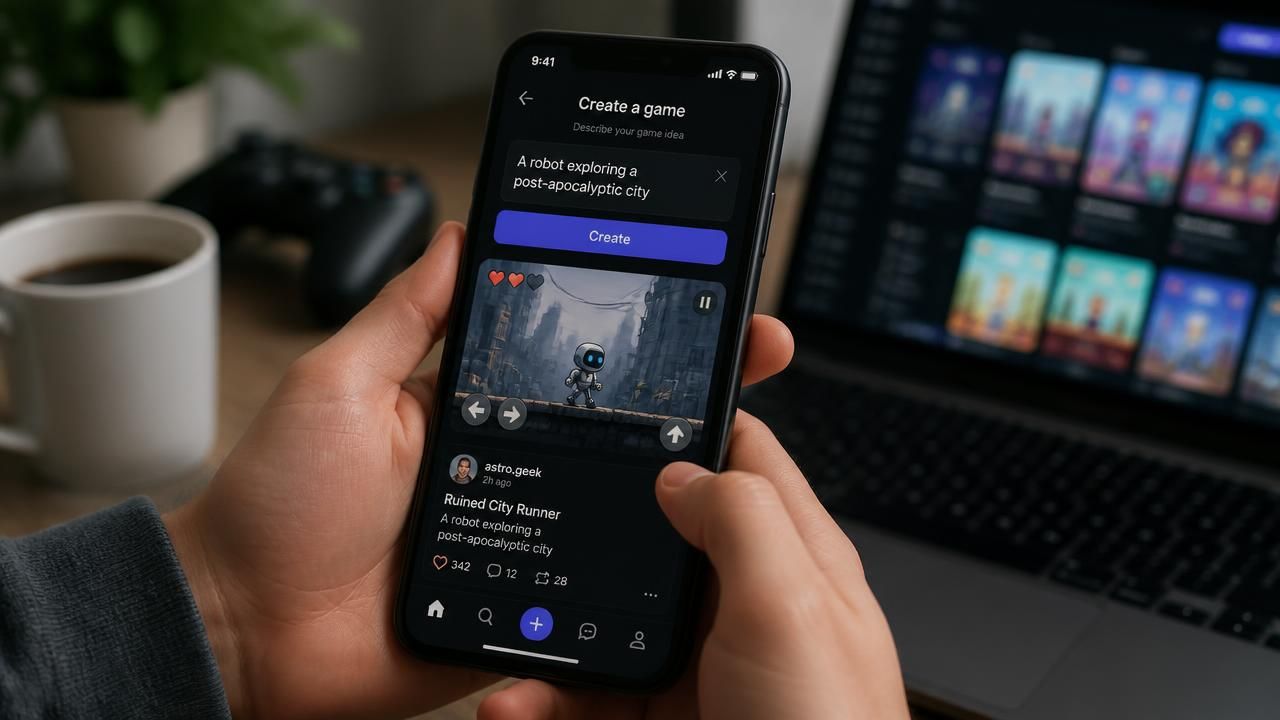
Meta has officially entered the world of "vibe coding" with Pocket, a new mobile app that lets users create fully interactive video games simply by typing text prompts. Released in the United States on Friday, August 21, Pocket is Meta's boldest attempt yet to democratize game development, blending generative AI with the addictive pull of a social media feed. The app is the product of Meta's acquisition of Gizmo, a startup whose staff joined the tech giant in March, bringing with them a vision of no-code, AI-powered game creation.
Pocket transforms game development into something as casual as posting a status update. Users open the app, describe a game idea in plain English, and an underlying large language model generates a playable "gizmo" on the spot. There is no code to inspect, no technical knowledge required, and no barrier to entry beyond thinking of an idea. The resulting games are optimized for mobile, using tilt, swipe, and tap controls that mimic the intuitiveness of arcade classics. Once created, these gizmos can be published to an endless, TikTok-style vertical feed where other users can like, comment, repost, and remix them, turning game creation into a social experience that feels familiar to anyone who has used Instagram Reels or TikTok.
From Typing to Playing: The Experience
Early adopters have been pleasantly surprised by how well Pocket works. Ars Technica reviewer, who spent nearly a week with the app, described getting "hooked on the simple process of quickly standing up functional, relatively feature-rich game prototypes simply by chatting with an LLM." MSN's headline echoed that sentiment: "I made my own video games with Meta's new AI vibe-coding app and it was more fun than I expected." The app's magic lies in its ability to translate natural language into interactive logic, handling variables, physics, and user input behind the scenes while the creator focuses purely on imagination.
What sets Pocket apart from other AI coding tools is its focus on content sharing, not just creation. The app is designed as a social network first, with a feed that surfaces newly published games for others to try and rate. This combination is a departure from Instagram's photo-and-video focus, as MSN noted in its headline: "Forget Instagram, Meta's new social media app swaps photos and reels for your own AI-generated video games." It's a shift that could redefine what we consider social media content, moving from passive media to interactive software.
Democratizing Game Development
Pocket arrives at a time when AI-assisted coding tools have already begun upending software development. Tools like GitHub Copilot and the growing "vibe coding" movement have lowered the barrier for building apps, but they still require some familiarity with command lines, IDEs, and terminal-based workflows. Meta's app targets the millions who have never touched a line of code. By removing the code view entirely, Pocket makes the creation process as simple as sending a text message. This could open game development to a far broader audience, including children, educators, and hobbyists who have always had ideas but lacked the technical skills to realize them.
The app also carries the potential for educational and creative expression. Teachers could use it to help students design simple games that demonstrate logic and storytelling. Aspiring designers could prototype concepts before seeking more advanced tools. And for the average user, it's pure fun: a way to see an idea spring to life in minutes.
The Walled Garden Debate
However, the enthusiasm around Pocket is tempered by concerns about ownership and control. Ars Technica's reviewer was quick to point out the downside: after hours of creating games, they found that their creations were "effectively trapped in Meta's new walled garden, without any real way to turn them into something separate." All games exist within Pocket's ecosystem, and users have no ability to export code, move their games to other platforms, or even view the underlying logic that powers them. This is a stark contrast to traditional game development where the source code is the developer's property, and projects can be sold, ported, or archived independently.
“The result of all that time and AI effort is a couple of interactive toys that are effectively trapped in Meta's new walled garden.” — Ars Technica
This lock-in raises significant questions. What happens if Meta decides to kill the app? Pocket games could vanish, along with the time and creativity users invested in them. There is also the matter of intellectual property. Who owns the games generated by Pocket—the user, Meta, or the AI model that ties them together? Meta's terms of service will be a crucial document to scrutinize, but early observations suggest that the company holds broad rights to the content generated on its platform, a standard but contentious practice.
Industry and Creator Perspectives
Reactions from the developer community are mixed. Proponents see Pocket as a gateway that could inspire a new wave of developers who will eventually want to learn real coding to break free of platform limitations. Critics argue that by housing everything in a closed system, Meta is undermining the very spirit of creativity and autonomy that drives innovation. The company, for its part, is positioning Pocket as an extension of its AI-first strategy, which already includes generative models for text, images, and video. With Pocket, Meta is betting that the next killer app is not a single game, but a platform for making games.
Other tech outlets, including Digital Trends and Unite.ai, covered the launch, though some encountered technical difficulties accessing the app on day one. This buzz suggests that Pocket is more than a novelty; it represents a notable shift in how a major platform approaches both AI and user-generated content. The acquisition of Gizmo, which had already championed no-code game creation, gave Meta a talented team and a head start in this niche.
The Future of Vibe Coding and Social Platforms
The arrival of Pocket fits a broader trend of generative AI moving from productivity tools to entertainment. While other apps let users generate images or text, Pocket claims to let them generate software itself. It's an ambitious vision, but one that comes with built-in limitations. The lack of programmability means that complex, multi-level games are likely out of reach. The closed ecosystem also prevents the kind of community-driven open-source development that has fueled the web for decades.
Still, for the casual user, Pocket is an undeniably magical experience. It democratizes creation in a way that few tools have achieved before, making game ideas accessible to anyone with a smartphone and an imagination. But whether it becomes a transformative platform or a cautionary tale about corporate control of creativity may depend on how Meta balances its business interests with the needs of its nascent creator community. As the walled garden fences grow taller, the question for users is whether the convenience is worth the cost of freedom.
For now, Pocket is a fun, funny, and occasionally thrilling place to waste an afternoon. But for those with aspirations of building something lasting, the message is clear: your AI-coded dreams live in Meta's house, and Meta makes the rules.