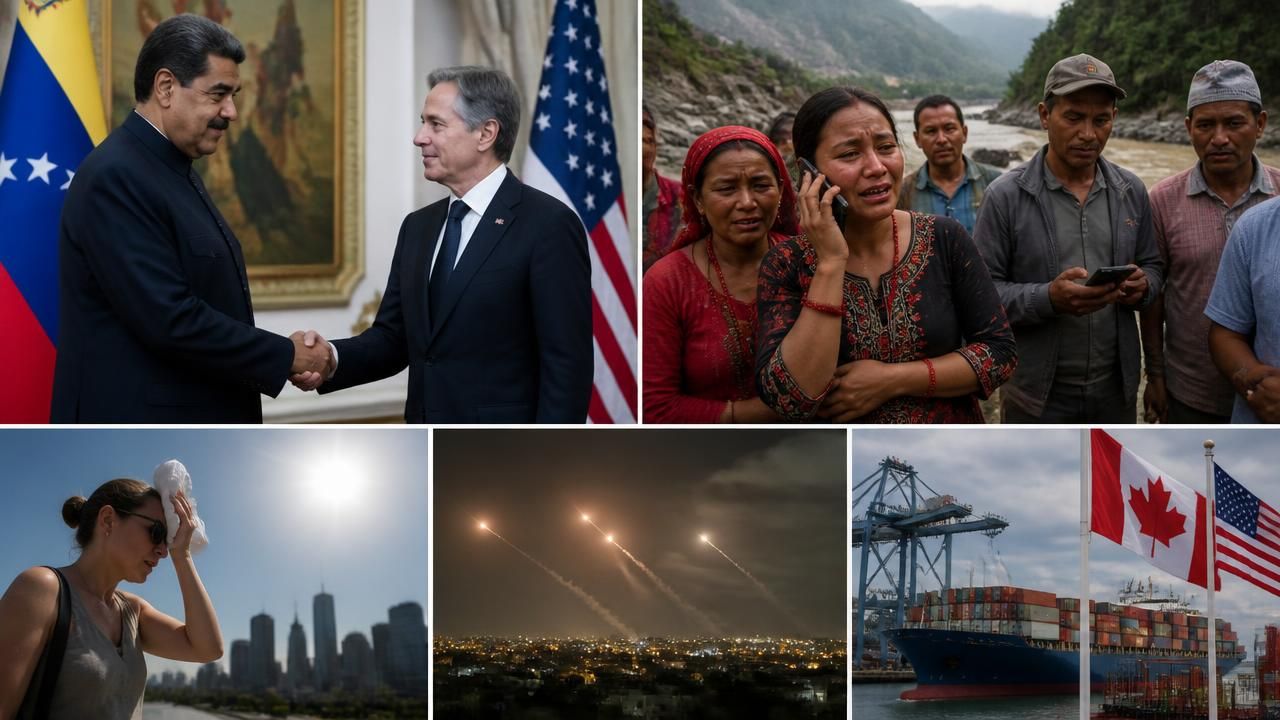
This week's global news landscape is a study in interconnected crises and diplomatic gambits. The United States and Venezuela have struck an oil deal that analysts say will do little to ease American gasoline prices. A two-year NPR investigation reveals that official records dangerously undercount heat-related deaths in the U.S. In Nepal, families are desperately seeking news of pilgrims caught in devastating floods, while attacks between the U.S. and Iran have flared after a monthlong pause. And in North America, Canadian Prime Minister Mark Carney has declared that his nation is effectively “at war” with the United States over tariffs. Here is a detailed look at each story.
U.S.-Venezuela Oil Deal: A Diplomatic Shift With Limited Relief at the Pump
The Biden administration has quietly negotiated a significant policy reversal with Venezuela’s authoritarian government, striking a deal that allows for expanded oil exports from the South American nation. According to NPR, the agreement is part of a broader effort to stabilize global energy markets and encourage democratic reforms, but it carries considerable political risk for a White House that has faced criticism for engaging with Nicolás Maduro’s regime.
Yet, as KNPR.org’s headline bluntly states, “The U.S. Venezuela oil deal won't lower your gas prices.” The outlet explains that Venezuela’s oil infrastructure has been in decline for decades, and even with sanctions relief, production increases will be slow and incremental. Furthermore, U.S. Gulf Coast refineries are not configured to process Venezuela’s heavy sour crude, meaning new barrels may be shipped to other markets rather than to the United States.
Oil analysts point out that global crude markets are already oversupplied, and any additional Venezuelan output will be negligible. The real benefit, they argue, is geopolitical: widening access to Venezuelan oil could undermine Russian influence in the region and provide Maduro with a financial lifeline in exchange for future political concessions.
Key Takeaways
- The deal allows Chevron to resume drilling and export operations on a limited basis.
- Maduro has agreed to return to negotiations with the opposition in Mexico City.
- Gas prices in the U.S. are unlikely to decline as a direct result of this pact.
NPR Investigation: The Hidden Toll of Heat Deaths in America
While the oil deal captures headlines, a quieter crisis is unfolding across the United States. NPR spent two years examining medical examiner records, death certificates, and temperature data to track the true toll of extreme heat. Their reporting uncovered that official counts of heat-related deaths are dramatically understated, with many fatalities attributed to heart attacks, respiratory failure, or other causes that obscure the role of high temperatures.
The investigation found that in many jurisdictions, clinical records rarely mention heat, even when a physician or coroner notes it in a narrative report. Health experts say that heat is the deadliest weather phenomenon in the U.S., killing more people each year than hurricanes, floods, or tornadoes, yet it receives far less attention. The hidden toll is expected to grow as climate change makes heatwaves more frequent, intense, and longer-lasting.
This story is not just about data; it’s about accountability. Cities like Phoenix and Las Vegas have begun investing in cooling centers and urban tree canopies, but many communities remain unprepared. The NPR report calls for a national system to systematically identify and track heat-related mortality, echoing recommendations from public health researchers who describe the official counts as “a dangerous blind spot.”
Nepal Floods: Families Desperate for News of Missing Pilgrims
In the mountainous heart of Nepal, disaster has struck a region known for its sacred pilgrimage routes. Flash floods and landslides, triggered by relentless monsoon rains, have swept through remote villages and mountainside trails, leaving dozens of pilgrims missing. WGLT reports that families across South Asia are desperate for word from their loved ones, but communication infrastructure has been severely disrupted, and rescue teams are struggling to reach cut-off areas.
The incident highlights the vulnerability of Nepal’s Himalayan communities, which are increasingly prone to climate-driven disasters. The government has dispatched army helicopters and disaster response teams, but rugged topography and unstable weather conditions are hampering efforts. Local officials report that at least 100 people remain unaccounted for, though the figure is uncertain as district reports are delayed.
Pilgrims from India, Bhutan, and other nations are often among the visitors, and their foreign ministries have set up hotlines for worried relatives. For now, those families can only wait, refreshing social media timelines and refreshing government websites that are slow to update. “Every minute feels like an eternity,” one relative told a local news outlet, speaking through tears.
U.S.-Iran Attacks Flare Again After a Monthlong Pause
The fragile calm that had settled over U.S.-Iran tensions has been shattered. After a pause of roughly a month, attacks have resumed between the United States and Iranian-backed forces, according to WGLT. The latest exchange underscores the precarious situation in the Middle East, where proxy conflicts and nuclear negotiations remain intertwined.
While details are still emerging, initial reports indicate that Iranian-backed militias launched a drone strike on a U.S. base in Syria, and the U.S. responded with targeted airstrikes on militia positions in Iraq. No U.S. casualties were reported, but the escalation signals that neither side is willing to back down. U.S. officials maintain that they are acting in self-defense, while Iran’s proxies view the American presence in the region as an occupation.
This renewed clash comes amid stalled diplomatic efforts to revive the 2015 nuclear deal. Moderates in both countries face pressure from hardliners, making any path to de-escalation difficult. The international community is watching closely, as another full-blown confrontation in the Persian Gulf could disrupt global oil shipments and draw in other regional powers.
Canada’s Mark Carney: ‘At War’ With the United States Over Tariffs
In a sharp escalation of the North American trade conflict, Canadian Prime Minister Mark Carney has issued a defiant warning to Washington. “We are at war with the United States,” Carney said, speaking at a press conference in Ottawa, as reported by HPPR. His comments came as Canada readied a round of retaliatory tariffs against U.S. goods, including steel, aluminum, and agricultural products.
The immediate catalyst was the U.S. decision to reimpose tariffs on Canadian steel and aluminum, citing national security. However, the dispute has broader implications, touching on dairy quotas, digital services taxes, and the future of the USMCA trade agreement. Carney’s language is strikingly forceful, reminiscent of the 2018 trade war but with a new urgency.
Economists warn that a full-blown trade war could wreak havoc on cross-border supply chains that are deeply integrated, particularly in the automotive and energy sectors. Canada is America’s largest trading partner, and millions of jobs depend on the free flow of goods. The “at war” rhetoric may be hyperbolic, but it reflects a genuine rupture in relations. Both sides claim they are defending their industries, but neither appears willing to blink first.
Conclusion: A World in Flux
These disparate stories share a common thread: the United States is reassessing its role in a world where old assumptions no longer hold. The Venezuela deal, the growing awareness of climate health disasters, the unrelenting geopolitical competition in the Middle East, and the increasing friction with allies like Canada all point to a moment of transition. The news media captures these events from different angles—NPR framing both the oil deal and the heat crisis as national stories, KNPR focusing on consumer impact, WGLT bringing local voices from Nepal and the conflict with Iran, and HPPR zeroing in on the trade war. Together, they offer a portrait of a planet grappling with the consequences of climate change, geopolitical rivalry, and shifting economic alliances.