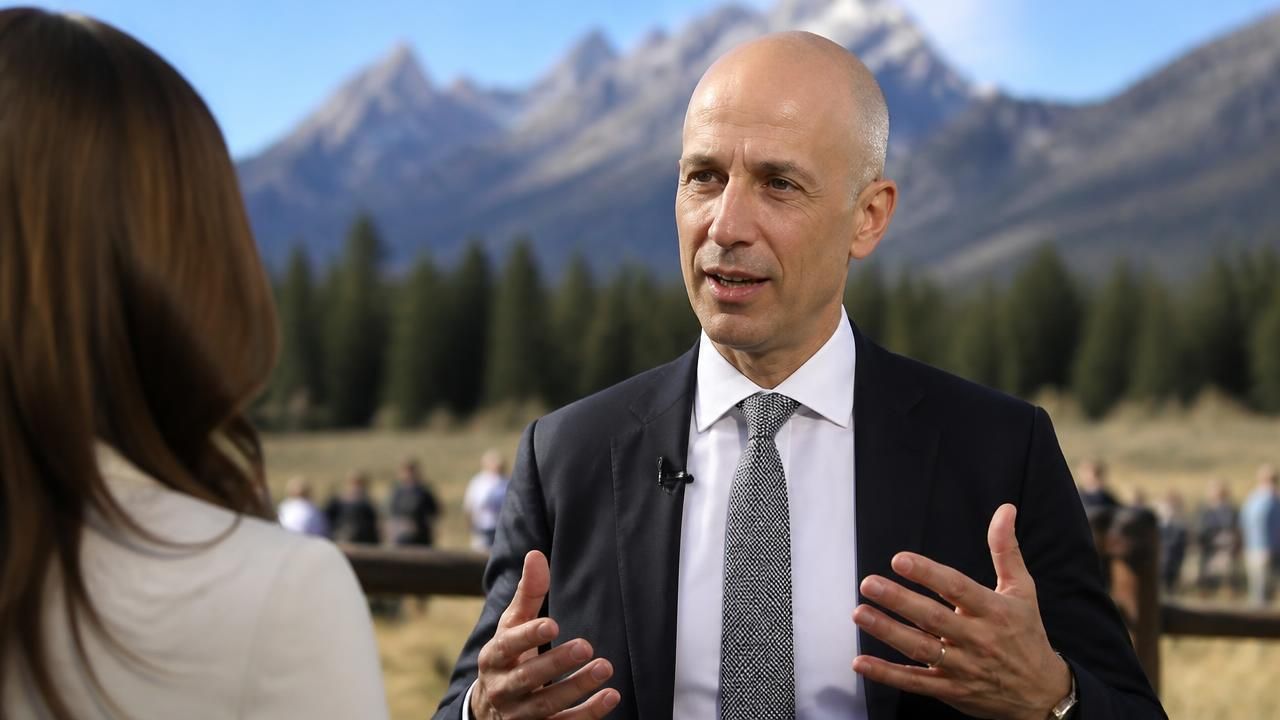
JACKSON HOLE, Wyoming – European Central Bank Governing Council member Martin Kocher struck a cautiously optimistic tone on Friday, saying the euro-area economy is showing "more momentum" than many believe, even as he acknowledged new inflationary pressures from geopolitical tensions and signaled that the ECB's next policy move rests on a knife's edge between a hike and a hold.
Speaking on the sidelines of the Federal Reserve's annual economic symposium in Jackson Hole, Kocher told Bloomberg's Lisa Abramowicz that the European economy is "more resilient than many people think," adding that it "is showing some momentum now, more momentum." His remarks offered a counterpoint to the gloom that has dominated European growth discussions for much of the past year, reinforcing the view that the bloc may be turning a corner.
Momentum Meets Geopolitical Risk
Kocher's upbeat assessment came with a caveat: the escalating conflict involving Iran is feeding into energy and commodity prices, creating fresh headaches for inflation fighters. According to a report by Bloomberg, the ECB "faces pressure to hike as Iran war feeds prices," a dynamic that Kocher said bears close watching. He noted that the central bank will be monitoring for potential "second-round effects" in inflation over the coming months—a reference to the risk that higher energy costs could spill into wages and broader price-setting behavior.
The combination of nascent economic momentum and renewed price pressures sets up a delicate challenge for the ECB's Governing Council when it meets in September. Kocher made clear that the decision is binary: "September meeting will be a hike or hold," he said, according to a Bloomberg headline that captured his remarks. That framing suggests the doves who have argued for a pause are struggling against hawks who see the Iran-driven price spike as a reason to keep tightening.
Balanced Risks, Uncertain Outlook
Despite the geopolitical storm clouds, Kocher characterized the euro-area inflation risks as "quite balanced." The comment, reported by Bloomberg, hints that he does not currently see inflation running away in either direction—a stance that could justify either a final rate increase or a prudent pause. The euro zone's inflation rate has been on a downward trajectory for months, but the recent spike in oil and natural gas prices, exacerbated by the Iran conflict, threatens to reverse some of that progress.
Kocher's colleague on the Governing Council, speaking separately to Reuters, flagged concerns about the weak dollar—a topic that has animated currency markets at the symposium. A softer dollar tends to push up import prices in Europe and can complicate the ECB's inflation fight by making dollar-denominated commodities more expensive. While Kocher did not directly address the currency issue in his own remarks, the broader sentiment among ECB policymakers is that the exchange rate is an additional variable in the policy calculus.
"The European economy is more resilient than many people think, it is showing some momentum now, more momentum." — Martin Kocher, ECB Governing Council member
September Showdown at the ECB
The ECB has already raised its benchmark deposit rate to a record high of 4% after a historic string of hikes. But with the economy stagnating and inflation easing, officials are deeply split over what to do next. Kocher's "hike or hold" framing suggests the hawks are not yet ready to concede defeat, especially with the Iran conflict injecting fresh uncertainty into energy markets.
Financial markets, meanwhile, have priced in a roughly 40% chance of a 25-basis-point hike in September, according to swaps data. The decision will hinge on incoming data—particularly inflation prints for July and August, along with second-quarter wage growth figures that are due before the meeting.
Context for the Debate
- Economic resilience: The euro zone unexpectedly avoided a recession in the first half of 2023, and recent PMI readings show the services sector stabilizing, even as manufacturing remains weak.
- Inflation trajectory: Headline euro-area inflation fell to 5.3% in July, down from a peak of 10.6% last autumn, but core inflation (excluding energy and food) remains sticky at 5.5%.
- Geopolitical shock: The Iran war has disrupted shipping lanes and spooked energy markets, with Brent crude trading above $85 a barrel—adding to the ECB's hawkish case.
- Global central bank coordination: Kocher was also listening to Fed Chairman Kevin Warsh's speech at Jackson Hole, which many observers interpreted as a signal that the Fed will hold rates steady. The transatlantic policy gap is a key driver of the dollar's weakness.
Diverging Frames at Jackson Hole
The various headlines out of Jackson Hole capture how different outlets are framing Kocher's message. Bloomberg's market desk emphasized the positive momentum and resilience, while its more recent coverage highlighted the Iran-war inflation pressure and the hike-or-hold dilemma. A separate Bloomberg headline focused on Kocher's "quite balanced" inflation risks—a nuance that could be read as a subtle dovish tilt. Reuters, meanwhile, steered attention to the broader debate among ECB officials about the weak dollar, which some worry could import inflation and undermine the ECB's efforts.
This range of frames underscores the complexity of the ECB's position: The economy is improving, but not robustly; inflation is easing, but not enough; and external shocks are adding noise. Kocher's own balancing act—acknowledging momentum while keeping all options open—may be the most accurate preview of what the September meeting will bring.
Implications for Markets and Policy
Investors will be scrutinizing every word from ECB officials in the coming weeks, particularly after the Jackson Hole symposium. If the September meeting ends with a hike, it would be the ECB's 10th consecutive increase and could push rates further into restrictive territory. A hold, on the other hand, would signal that the cycle has peaked, potentially lifting European bonds and pressuring the euro.
For Kocher, the path forward is clear: "We have to be data-dependent and watch carefully how the situation evolves," he implied. With the euro zone sailing through a narrow strait between economic fragility and inflationary storms, Kocher's steady hand—and his explicit framing of the choice ahead—gives markets a clearer sense of the ECB's immediate horizon.
Reporting from Jackson Hole, Wyoming. This article synthesizes coverage from Bloomberg and Reuters.