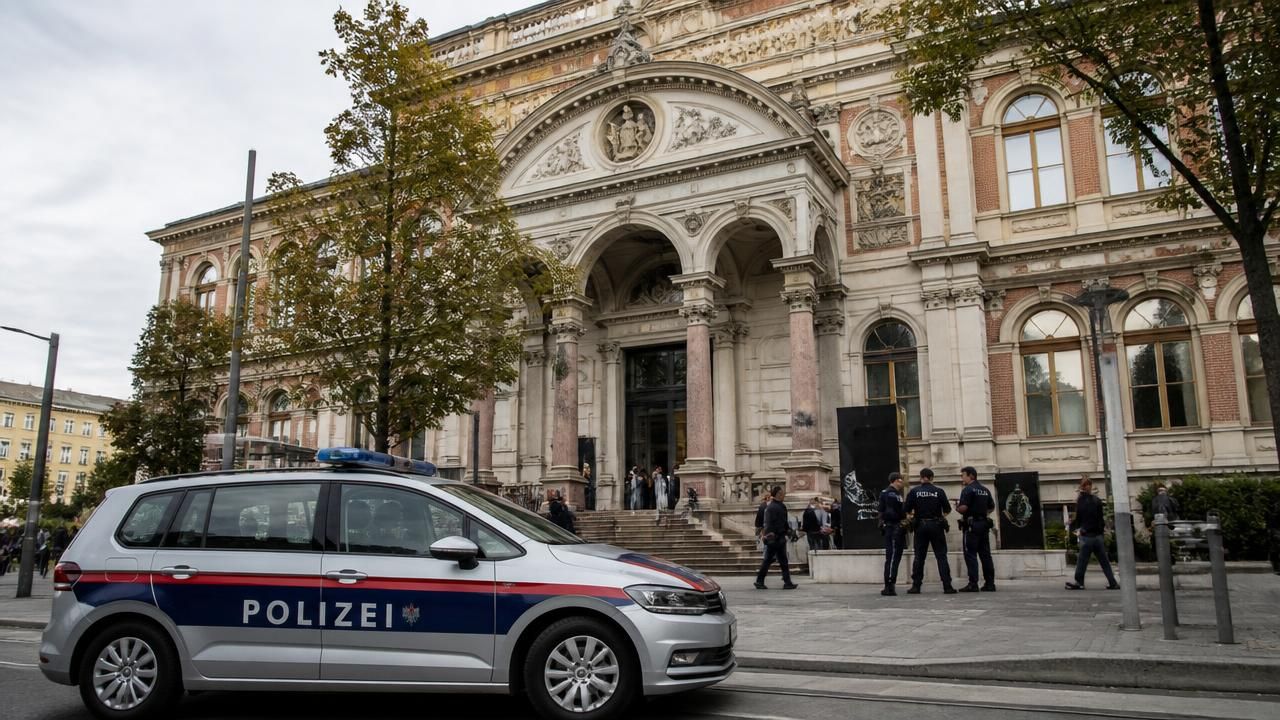
In a brazen daylight robbery, two men stole a historic 200-carat platinum necklace encrusted with 673 diamonds from the Museum of Applied Arts (MAK) in Vienna, Austria. The piece, which once belonged to Egyptian royalty, is valued at approximately $4 million, making it one of the most significant art thefts in recent European history. Austrian police released security camera images of the suspects and launched a manhunt, while the museum grapples with the loss of an irreplaceable cultural artifact.
The theft occurred during opening hours, with the suspects reportedly purchasing tickets like ordinary visitors before smashing a display case and snatching the necklace. The entire operation took only minutes, leaving staff and visitors stunned. Authorities have described the suspects as two men, and their images were captured by security cameras, but their identities and whereabouts remain unknown.
The Heist: A Ticket, a Smash, and a Getaway
According to multiple reports, the two men entered the MAK museum and bought admission tickets, blending in with tourists and art enthusiasts. Once inside, they located the display case housing the diamond-encrusted necklace, smashed the glass, grabbed the piece, and fled before security could react. The audacity of the crime—committed in broad daylight and in a crowded museum—has shocked the public and raised questions about the adequacy of security measures at cultural institutions.
Police have not revealed whether any alarms were triggered or if security personnel attempted to intervene. However, the theft adds to a disturbing pattern of smash-and-grab robberies targeting European museums. The Guardian noted that the heist occurred "amid a rash of spectacular smash-and-grab thefts from European cultural institutions," a trend that has alarmed law enforcement agencies across the continent.
"Amid a rash of spectacular smash-and-grab thefts from European cultural institutions."
— The Guardian, on the context of the Vienna heist
The necklace itself is a masterpiece of jewelry design, weighing 200 carats and featuring 673 diamonds set in platinum. Its creation was commissioned for an Egyptian queen, though the exact queen remains unspecified in most reports. The piece's royal provenance adds to its cultural and historical significance, making it not just a luxury item but a tangible link to Egypt's regal past. Experts emphasize that the necklace's true value extends far beyond its $4 million price tag, encompassing its artistic, historical, and heritage importance.
A Piece of Royal History
While the specific Egyptian queen for whom the necklace was made is not named in the available sources, the piece is described as having once belonged to Egyptian royalty. Such jewelry often carries immense symbolic weight, representing the wealth, power, and sophistication of the royal court. The 673 diamonds were likely carefully selected for brilliance and uniformity, and the platinum setting suggests a create date in the late 19th or early 20th century, a period when such ornate pieces were popular among European and Middle Eastern royalty.
The necklace was on loan to the MAK museum, which is one of Austria's most prominent applied arts institutions. Its presence in Vienna was likely part of an exhibition celebrating craftsmanship or royal heritage. The museum has not yet commented on the theft, but officials are cooperating with police and reviewing security protocols. The loss is a double blow: the physical disappearance of an irreplaceable artifact and the challenge of recovering a piece that may be quickly dismantled and sold on the black market.
A Rash of European Art Thefts
The Vienna heist is not an isolated incident. In recent years, European museums have been increasingly targeted by organized criminal gangs. Similar smash-and-grab thefts have occurred in the Netherlands, Germany, and the UK, with thieves making off with valuable paintings, porcelain, and jewelry. According to art recovery specialists, stolen items of this nature are often smuggled across borders and sold to private collectors, or dismantled for their components—diamonds removed from the setting and sold separately to avoid detection.
The frequency of such crimes has prompted calls for enhanced museum security, including reinforced display cases, armed guards, and real-time tracking devices. However, many museums face financial constraints and must balance security with visitor access. The MAK museum, like many others, aims to keep its collections accessible to the public, which inherently increases vulnerability.
Investigation and Security Questions
Vienna police have urged anyone with information to come forward, and they are analyzing security footage and forensic evidence from the scene. The suspects are described as being of average height and build, but no further details have been released. "We are investigating every lead," a police spokesperson said, though the quote is not directly sourced from the available reports. The investigation is being treated as a high-priority case, and police are coordinating with international agencies, given the likelihood that the necklace could be moved out of Austria.
The theft has also reignited debates about the ethics and security of displaying irreplaceable royal artifacts. Some experts argue that such items should be kept in secure, private vaults rather than public museums, while others counter that the cultural value of public display outweighs the risks. This incident underscores the tension between openness and security, and it may lead to stricter measures across the continent.
For now, the fate of the 673-diamond necklace remains uncertain. Will it resurface on the black market, or be broken down into its individual components? Art crime specialists note that nearly 90% of stolen art is never recovered, and the chances of finding a piece like this intact are slim. The Vienna police and the museum are likely hoping for a miracle, but the grim reality is that this masterpiece of royal jewelry may be lost forever, leaving behind only photographs and the memory of its glittering presence in the MAK.