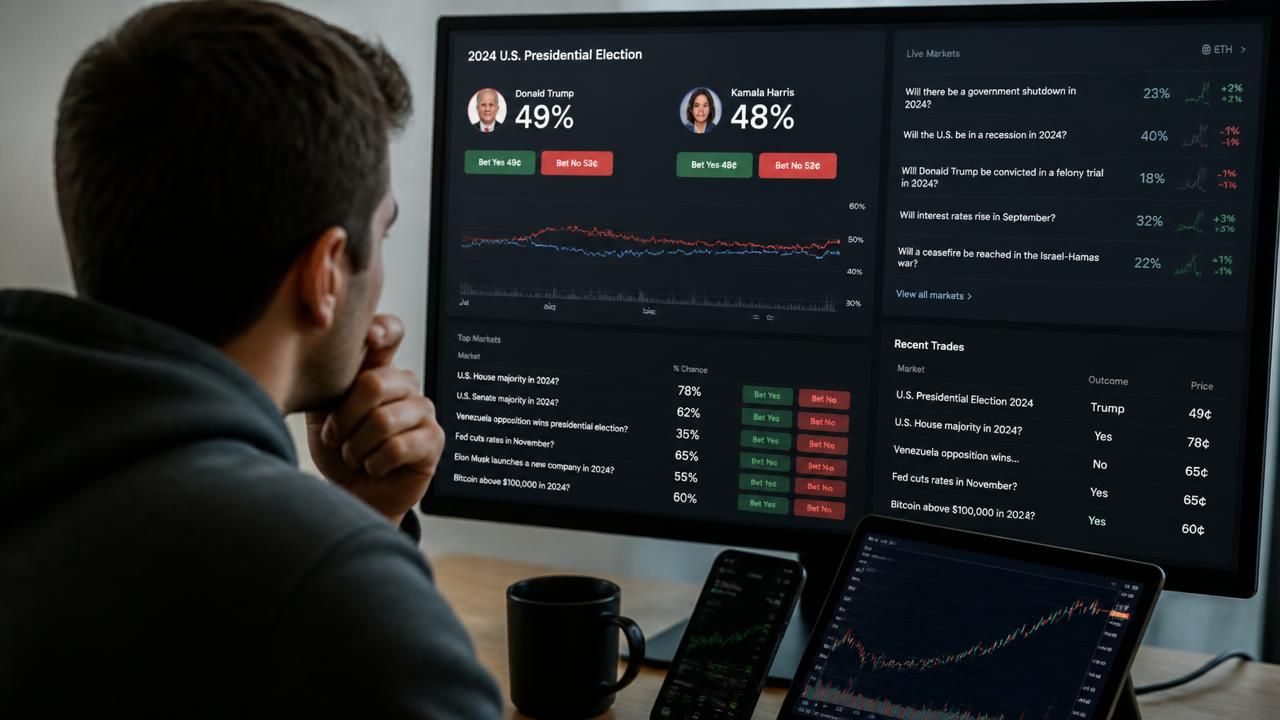
The U.S. midterms are nearly upon us, and with them a surge of activity on prediction markets—platforms that let users bet on everything from congressional outcomes to Venezuelan elections. But a recent stunt involving fake polls has laid bare the fragility of these markets, raising new questions about their integrity and influence. While the bogus surveys may not have been an attempt to rig betting odds, as NPR reported, concerns are growing that other bad actors could exploit these easily-manipulated tools to distort public perception and financial gain.
Prediction markets have long been touted as a revolutionary way to aggregate information and forecast events. In theory, the wisdom of crowds produces remarkably accurate predictions. Yet as a recent Bloomberg piece, “Bets on Maduro, Jesus Reveal Promise and Risks of Prediction Markets,” points out, the same openness that makes these markets innovative also makes them vulnerable. From speculating on Vladimir Putin’s next move to the Second Coming, the range of wagers is as vast as human imagination—and equally susceptible to fraudulent actors wielding misinformation.
The real problem with polls
Beyond the immediate controversy, there is a deeper issue: the relationship between polls, media coverage, and prediction markets. As Gabe Fleisher of Wake Up to Politics argues in “The Real Problem With Polls,” the problem isn’t merely statistical inaccuracy; it’s how polls are weaponized to shape narratives. When fake polls circulate online, they can sway not only voters but also the algorithmic trading systems that feed on public sentiment. Prediction markets, far from being neutral arbiters, become amplifiers for whatever data—real or fabricated—is pushed into the system.
“While a stunt involving fake polls may not have been an effort to rig prediction markets, concerns are growing ahead of the midterms about other attempts to influence the betting sites.” — NPR
This is not just a hypothetical worry. In recent election cycles, organized disinformation campaigns have targeted everything from social media to polling aggregators. Why should betting platforms be immune? The accountability is lower: most prediction markets are unregulated, or exist in a legal gray area. A well-timed bogus survey could shift odds, triggering cascading trades that generate profits for the manipulators—leaving regular users to navigate a rigged game.
Economic forecasts and the central bank signal
The same dynamics extend far beyond elections. In Japan, the Bank of Japan’s Governor recently signaled that a rate hike could come as early as December, a comment that immediately sent the yen and government bond yields higher, according to Reuters. This is a reminder that markets are always parsing every statement, tweet, or leak for predictive value—and that even the most cautious official language can become a self-fulfilling prophecy. But what happens when the predictions are wrong? Volatility, mispriced assets, and a loss of public trust in institutions that are supposed to be steady hands at the wheel.
Central bankers have long understood that managing expectations is as important as managing interest rates. In that sense, they are participants in the prediction economy, using forward guidance as a policy tool. But the explosion of prediction platforms introduces new variables—non-state actors who can place huge bets and thereby influence real-world decisions, all while escaping the disclosure requirements that bind traditional market participants.
AI and the anxiety of the future
Prediction isn’t limited to finance and politics; it’s also shaping how we feel about technology. A Guardian poll found that half of UK adults worry that AI will take or alter their job. That statistic, drawn from a standard public-opinion survey, feeds directly into predictions about automation and economic disruption. Those fears may be exploited by political entrepreneurs or used by tech companies to justify extraordinary investments. Yet the very unpredictability of AI’s trajectory makes such predictions shaky—a point lost in the hype cycle.
The spectacle of the news cycle
Some events defy prediction altogether. In a surreal twist, a bill to rename Lake Ontario to “Lake America,” reportedly at the behest of former President Trump, illustrates how political theater can break all models. Such proposals are rarely passed, but they dominate the news cycle, creating noise that prediction markets must filter. The oceanstatemedia headline serves as a reminder that the real world often outpaces the algorithms, and that many of the most consequential events are fundamentally irrational.
On the cultural front, the release of a new album by the band Big Thief—“a glimpse at the power and wonder of creation,” as one headline put it—offers a counterpoint to the prediction industry’s numbers-obsessed worldview. Art is unpredictable, human, and intangible; it resists the commodification that prediction markets thrive on. Perhaps that is why we need it more than ever.
What lies ahead?
As the midterms approach, the intersection of polls, prediction markets, and public trust demands closer scrutiny. Regulators have taken tentative steps toward oversight, but the landscape evolves too quickly for any single rulebook. Meanwhile, citizens are left to wonder: are these markets a genuine source of collective intelligence, or just another tool for the powerful to shape reality?
In the end, the fake-poll stunt may be a canary in the coal mine. It exposes the fragility of systems we increasingly rely on to make sense of a chaotic world. Whether we are betting on the next Congress, the next rate hike, or the next technological revolution, our predictive tools are only as reliable as the people and institutions that feed them. As the line between information and manipulation blurs, the most vital skill may no longer be forecasting the future—but in knowing what to trust in the present.