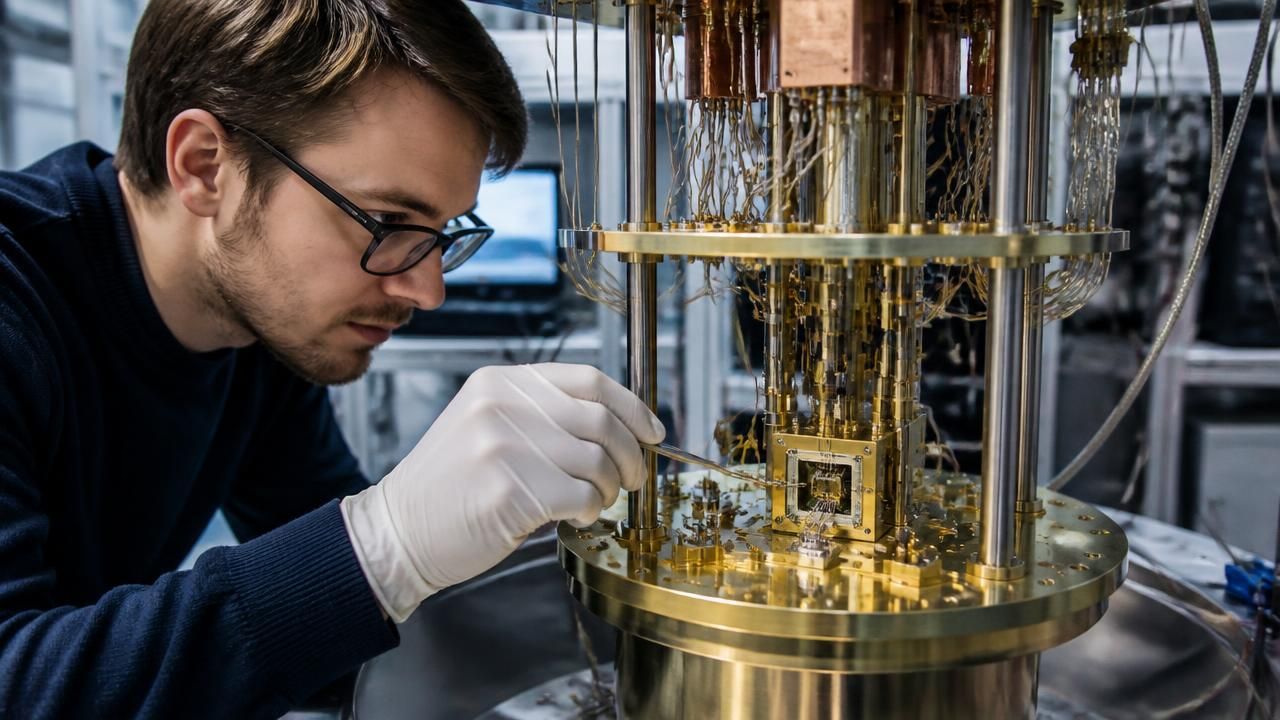
In a groundbreaking experiment that blurs the line between thermodynamics and quantum mechanics, researchers at Aalto University in Finland have built and operated the world's first superconducting quantum heat engine. This tiny device converts heat near absolute zero into useful mechanical work, a feat that could one day unlock the next generation of quantum computers by eliminating the bulky, noisy microwave cables that currently plague these incredibly sensitive machines.
The achievement, covered by outlets from Science Daily to Quantum Zeitgeist, marks a significant step toward practical quantum technology. Unlike traditional heat engines—which rely on steam or gas to drive pistons—this quantum version operates on the bizarre rules of quantum mechanics, where energy levels are discrete and particles can exist in superposition. The engine is a superconducting circuit that cycles through quantum states, extracting energy from the heat bath of its environment and converting it into work, all at temperatures just a fraction above absolute zero.
A Leap from Theory to Practice
While quantum heat engines have been proposed for decades, previous demonstrations were confined to single-atom or single-ion systems, often requiring external lasers or magnetic fields to drive the cycle. The new device, described by researchers as a 'cyclic quantum heat engine,' is the first to be made entirely from superconducting components, which are the same building blocks used in modern quantum processors. This means it could potentially be integrated directly into quantum circuits, operating autonomously without external 'controls' that generate heat and noise.
'Future versions could operate autonomously inside quantum computers, potentially eliminating huge numbers of costly, noise-producing microwave cables,' explained the team in their announcement—a quote echoed by Science Daily. In current quantum computers, thousands of coaxial cables must carry microwave control signals down into the dilution refrigerator to manipulate qubits. These cables are not only expensive and physically massive but also introduce thermal noise and signal attenuation, limiting the scale of the machine.
How It Works
The superconducting heat engine operates on a quantum Otto cycle, a fundamental thermodynamic cycle adapted for quantum systems. It uses two quantum energy levels as its 'working fluid' and a series of gates to manipulate these states. The engine is placed in thermal contact with a hot bath and a cold bath—both at millikelvin temperatures, with the hot bath slightly warmer than the cold bath. By cyclically tuning the energy gap and allowing the system to exchange heat with these reservoirs, the device generates coherent oscillations that amount to useful work.
One of the most striking aspects is that the engine's entire 'mechanical power' is delivered in the form of microwaves—photons that carry quantized energy. In a quantum computer, this microwave power could be used to directly drive qubits without needing external microwave sources, effectively making the computer self-contained and drastically simplifying its architecture.
Why Quantum Computers Need This
Modern quantum computers face a scalability dilemma. The more qubits you add, the more control lines you need, which increases heat load and noise, ultimately degrading the quantum coherence that makes the machines special. Current systems have reached around 100 to 1,000 qubits, but millions of qubits will likely be required for practical applications like breaking encryption or simulating complex molecules. Peripheral components like microwave cables are a major bottleneck.
A superconducting quantum heat engine that can generate microwaves on-chip, directly from the ambient heat of the refrigerator, could replace this wiring harness. It would also recycle waste heat that naturally flows into the system, improving energy efficiency—a concept analogous to 'waste heat recovery' in macroscopic power plants. The researchers believe that with further development, these engines could power a 'quantum processing unit' autonomously, allowing quantum computers to scale beyond current limits.
Context and Broader Implications
The achievement builds on decades of research in stochastic thermodynamics and quantum information. It demonstrates that the laws of thermodynamics hold at the quantum scale, and that quantum coherence can be harnessed to do practical work. This is not just about quantum computers; it could also lead to ultra-sensitive sensors, quantum refrigerators that cool other components, and a deeper understanding of the quantum-classical boundary.
However, experts caution that the current engine is a proof-of-concept, not a commercial component. Its power output is minuscule, and integrating it into a full quantum computer will require solving engineering challenges. Still, the scientific community has responded with enthusiasm. 'This is a beautiful experiment that shows thermodynamic cycles can be realized in scalable solid-state devices,' said a commentary accompanying the study, which was covered by multiple outlets including phys.org and EurekAlert! (though those sites were briefly obstructed on initial access). The research has been widely touted as 'a path to larger quantum computers' by RealClearScience and The Brighter Side of News.
The Road Ahead
The team at Aalto is already working on next steps: increasing the engine's efficiency, integrating it with actual qubits, and developing a version that can cool its own environment—a 'quantum refrigerator' that might one day replace some layers of the dilution refrigerator. If successful, the era of autonomous quantum devices could begin.
'This is the first time a quantum heat engine has been realized in a superconducting platform, and it opens up a new avenue for powering quantum technologies from within, rather than from tangled external wires.'
As quantum computers continue their march toward practicality, innovations like this heat engine remind us that the path to the future is often paved by mastering the most fundamental laws of the universe. The same interplay of heat, work, and entropy that powered the Industrial Revolution is now set to power the quantum revolution.