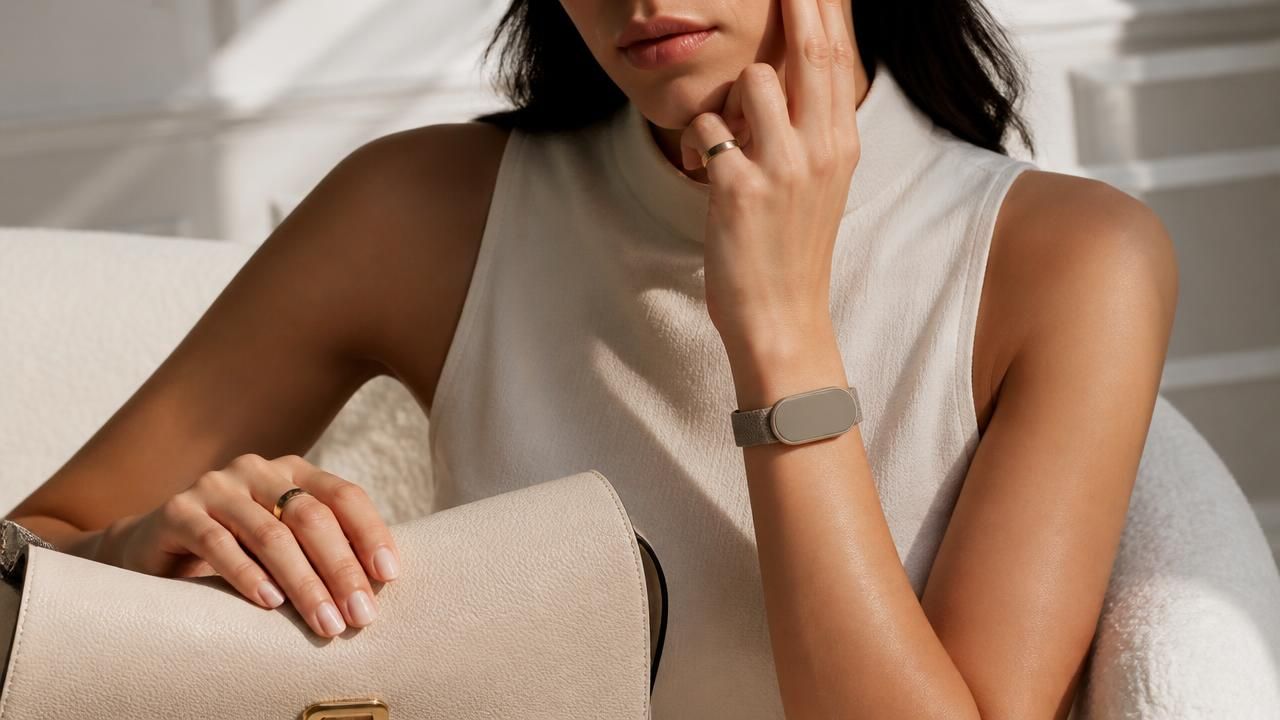
The line between what we wear and what we carry has never been thinner. The same week that The Verge declared “quiet luxury has come for wearables,” Vogue ran a headline about “wearable couture” dominating Paris runways, and Farfetch’s 2026 index crowned “wearable luxury” as the defining fashion trend. These are not parallel stories; they are one story about a massive cultural shift. Across tech and fashion, the loud, the flashy, and the screen-lit are giving way to something quieter, subtler, and far more functional.
This is the era of understated tech—where your health tracker looks like a wedding band, your couture gown is designed for actual movement, and even your breast pump is discreet enough to slip into a handbag. The convergence of “quiet luxury” and “wearable technology” is reshaping both industries, driven by economic uncertainty, digital fatigue, and an unmistakable desire for products that serve us without shouting.
The Screenless Revolution
For years, wearable tech has been synonymous with glowing screens, buzzing notifications, and a very visible “I’m tracking my steps” badge. But the new wave of wearables is almost aggressively invisible. In a recent column, The Verge’s senior reviewer Victoria Song described spending her summer vacation trailed by screenless gizmos: a Fitbit Air on one wrist, a Garmin Cirqa on the other, an Oura Ring 5 on her finger, and a Dexcom G7 continuous glucose monitor in her arm. Her only smart glasses were the display-free Meta Glasses.
“The wearable data generated? A metric crapton,” Song wrote, but the devices themselves were nearly undetectable. This is the “quiet luxury” of tech: advanced functionality wrapped in minimalist, jewelry-like designs. It’s a stark contrast to the chunky smartwatches of yesteryear, and it’s a direct response to a market that’s tired of flashing screens and constant pings.
The appeal is obvious. These devices promise the same health and productivity insights—heart rate, sleep quality, glucose levels, workout intensity—without turning your body into a billboard for consumer electronics. They’re designed to be seen by no one, yet they personalise everything. As Tech.co notes, wearable startups are increasingly betting on form factor sophistication: “It’s no longer enough to be smart; it has to look like you’re wearing nothing at all.”
Quiet Luxury Meets the Runway
Meanwhile, the fashion world has been on its own quiet journey. “Quiet luxury”—the aesthetic of logo-free, impeccably tailored, often expensive clothing—has been dominating headlines. Fashionista attributes this to economic uncertainty: “Consumers are gravitating toward investment pieces that communicate status through quality, not branding.” The Wall Street Journal went further, declaring “Dressing for Instagram is over” and that “wearable clothes won.”
This trend has exploded across every facet of fashion, from Harper’s Bazaar extolling “pink nails as the new quiet luxury manicure,” to Who What Wear building “a rich-looking wardrobe on a budget.” But the most telling shift is on the couture runways. Vogue reported that Paris couture week was dominated by “wearable couture”—garments that are exquisitely crafted yet genuinely movable, a departure from the theatrical, gravity-defying creations of previous seasons.
“We’re seeing a shift towards highly dimensional pinks with depth and personality,” said Daisy Kalnina, founder and CEO of The GelBottle Inc., in Harper’s Bazaar. “It’s all about finishes that play with light and give a sense of understated luxury.”
The same philosophy is driving fashion tech. Chanel, lauded for its quiet-luxury codes, has begun exploring tech integrations that preserve its aesthetic. Jing Daily reports that Chanel is turning to technology to enhance customer experiences without compromising its sleek image—an effort that includes virtual try-ons and AI-driven personalisation. Meanwhile, Condé Nast’s recent AI investments and Zepeto’s big bet on Emily in Paris indicate that the luxury-fashion-tech pipeline is only accelerating.
Function Meets Fashion: The Rise of Invisible Devices
Perhaps no category illustrates this convergence better than wearable breast pumps. Once a clunky, clinical necessity, breast pumps have been reborn as sleek, wearable, and discreet. Forbes and New York Magazine’s Strategist both published exhaustive roundups in 2026, testing over a dozen and eight wearable pumps respectively. The winners? Devices that tuck into a bra, operate silently, and look more like a tech accessory than a medical device.
This is a perfect case study in quiet luxury applied to functional tech. The pumps are expensive, premium, and sold on the promise of efficiency and elegance. They don’t scream “motherhood,” they whisper “I’ve got this.” The same logic applies to health trackers like the Oura Ring, which has become a fashion statement in its own right—worn by celebrities and Silicon Valley executives alike. The ring’s success proves that hiding the technology doesn’t hide the status; it amplifies it.
What’s Driving the Shift?
The drivers are multifaceted. First, economic uncertainty—both the pandemic hangover and ongoing inflation—has made conspicuous consumption feel out of touch. Fashionista notes that quiet luxury is “a response to a world in crisis.” Second, there’s digital burnout. As WSJ points out, social media has taught us to value mindfulness over spectacle. Third, there’s a genuine design evolution. Wearable tech has shed its geeky shell thanks to better materials and miniaturisation, while fashion has embraced technical fabrics and smart clothing.
Even the Farfetch Index, which tracks global fashion trends, lists “wearable luxury” as the top forecast for 2026. The report highlights that consumers are willing to pay more for items that combine superior craftsmanship with real-world utility. It’s no longer enough for a product to be beautiful; it must also be useful. And it’s no longer enough for a gadget to be functional; it must also be beautiful.
The Business of Stealth Wearables
For startups, this means opportunity. Tech.co outlines three major trends poised to hit wearable startups over the next few years:
- Discreet health monitoring — sensors embedded in rings, patches, and textiles that continuously track vitals without glaring displays.
- Fashion-first partnerships — collaborations between tech companies and luxury houses, similar to Chanel’s tech push, to create wearable devices that appeal to style-conscious consumers.
- Personalised wellness — devices that use AI to provide tailored health advice, shifting from passive tracking to proactive coaching, all while maintaining a minimal aesthetic.
Established players are taking note. The success of Whoop, which has always been screenless and subscription-based, has spawned copycats. As The Verge notes, “Whoop has no shortage of copycats now,” and each new contender is leaning further into discreet design. This is a signal that the market has moved beyond novelty and into maturity.
Will It Last?
The question on everyone’s mind is whether quiet luxury—and its technological counterpart—is a durable shift or just a passing mood. Fashionista addresses this head-on, citing experts who argue that economic downturns historically produce a retreat to conservatism, but that the current trend is different because it’s tied to genuine values of sustainability and mindfulness. Consumers are tired of buying junk; they want fewer, better things.
For wearables, the same principle applies. A screenless sensor that lasts for years, that you forget you’re wearing, and that seamlessly integrates into your life is the ultimate quiet luxury. It’s not about showing off the device—it’s about showing off the results: better health, better sleep, better control.
As we move into 2026, the fusion of fashion and technology is no longer a novelty. It’s the new standard. The future belongs to products that whisper, not shout. Whether it’s a couture gown you can actually walk in or a ring that monitors your heart rate, the message is the same: true luxury is not about how it looks to others, but how it feels to you.
And that, perhaps, is the most wearable trend of all.